
Outbound Lead Generation Services to Scale Your Revenue
If your revenue growth has started to feel a bit random, you've likely hit the classic B2B plateau. This is where outbound lead generation services come in—built to create a predictable sales pipeline right when your organic growth starts to feel anything but.
If your revenue growth has started to feel a bit… random… you've likely hit the classic B2B plateau. Your business is thriving on referrals and a steady trickle of inbound leads, but you have no real control over the gas pedal. This is where outbound lead generation services come in. They're built to create a predictable sales pipeline right when your organic growth starts to feel anything but.
Why Predictable Revenue Feels Out of Reach

For a lot of B2B leaders, relying on inbound and word-of-mouth feels like running a great little neighborhood shop. Business is good as long as people wander in, but you can't really control who comes through the door or when. It's a purely reactive model, and it creates a revenue rollercoaster that makes it impossible to forecast with confidence, hire the right people, or scale your operations.
The reality is, your ideal customers are drowning in noise. Breaking through requires a methodical, proactive system. This is where most in-house efforts stumble, because building a true prospecting machine from scratch is a monumental task.
The Problem with Building In-House
Trying to spin up your own outbound engine is far more complicated than just hiring a couple of sales development reps (SDRs). I've seen countless companies get bogged down by the same set of hurdles:
- Infrastructure: You need hundreds of sending domains and inboxes, all properly set up and warmed up, just to ensure your emails actually land.
- Data Sourcing: Finding accurate, verified contact info for your ideal customer profile (ICP) at scale is a full-time job in itself.
- Talent: You have to find, train, and manage a specialized team of SDRs, copywriters, and data experts—a huge drain on resources.
- Time: All said and done, it can easily take 6-12 months before a new in-house team produces a consistent, positive return.
This is precisely why outbound lead generation services have become such a powerful growth engine for B2B SaaS and service-based companies.
Think of it this way: Instead of trying to build your own factory from the ground up, you commission a specialized, pre-built facility designed for one purpose—producing qualified sales meetings.
These services aren't just selling you a list of names. They deliver a complete, managed system. That includes the strategy, the data, the technical setup, and the human expertise needed to put qualified appointments directly on your sales team's calendar.
In this guide, we're going to pull back the curtain on modern outbound lead generation services. You'll see what a winning system actually looks like, how to measure real business impact, and what separates the elite partners from the pack. The goal is simple: to give you a clear path toward the predictable revenue you need to truly scale.
What Are Outbound Lead Generation Services Exactly?
When most people hear "outbound lead generation," they picture cold-call sweatshops or dusty spreadsheets of purchased names. Let's be clear: that's not what we're talking about here. A modern outbound lead generation service is a sophisticated, done-for-you prospecting engine, built to deliver high-quality sales meetings, not just contact info.
Think of it this way. You could decide to build a high-performance race car from scratch—sourcing the raw materials, machining every part, and learning the complex engineering yourself. Or, you could partner with a professional racing team that already has the expert engineers, the high-tech garage, and a proven car ready to hit the track.
That's the real difference. You're not just buying a list of names; you're investing in a complete, managed system designed to put qualified meetings on your sales team's calendar.
More Than Just a List Vendor
A genuine outbound partner is a world away from a simple data vendor. They don't just hand you a list and wish you luck. Instead, a full-service provider builds and manages every single part of the outbound "assembly line" for you.
This breaks down into four critical functions:
- Go-to-Market Strategy: It all starts with the blueprint. An experienced partner digs in with you to sharpen your ideal customer profile (ICP), map out your total addressable market (TAM), and craft the messaging that will actually resonate.
- Data Sourcing and Enrichment: This is about finding the right people. Using a mix of advanced tools and human verification, these services build hyper-targeted lists of best-fit accounts and the specific decision-makers you need to reach, ensuring the contact data is accurate and up-to-date.
- Technical Infrastructure: Here's the heavy lifting most companies can't do alone. This involves setting up and "warming up" hundreds of dedicated sending domains and inboxes. This complex process is vital for maintaining high email deliverability and protecting your main company domain from being blacklisted.
- Human-Powered Inbox Management: This is where the magic happens. Real people monitor replies around the clock, fielding initial questions, navigating objections, and filtering out the noise. Only once a lead is confirmed to be a qualified, interested buyer is a meeting booked for your team.
The final deliverable isn't a spreadsheet. It's a booked appointment with a decision-maker who has explicitly agreed to talk to your sales reps.
The Role of Outbound in a Modern GTM Strategy
In a world obsessed with inbound marketing, it's easy to wonder if outbound still has a place. The answer is a resounding yes. While inbound leads from things like SEO are fantastic, outbound lead generation services give you something inbound can't: control. It allows you to proactively target the high-value accounts you want to win, even if they've never heard of you.
An outbound service gives you control over who you talk to and when. Instead of waiting for fish to swim into your net, you're sending a fleet of smart, targeted fishing boats directly to the most promising waters.
While some data places the average cost per lead across all marketing channels around $391.80, the real power of outbound is its precision. It cuts through the noise and accelerates conversations with your dream customers, bypassing the long, passive wait associated with inbound. You can dive deeper into these lead generation statistics and their sales impact on salesmate.io.
Ultimately, these services solve a huge bottleneck for B2B companies: the immense time, cost, and expertise required to build and run a world-class prospecting function. By working with a partner, you get immediate access to a proven system and a team of specialists, freeing up your sales reps to focus on what they do best—building relationships and closing deals. This is the foundation for creating predictable, scalable revenue growth.
The Anatomy of a High-Performing Outbound Engine
A top-tier outbound service isn't just about sending a bunch of emails. It's a sophisticated, multi-part machine built for one purpose: generating qualified meetings. As a revenue leader, knowing what goes on under the hood is the key to telling the difference between a real partner and a freelancer with a laptop.
Think of it like this: a high-performance engine needs more than just a powerful block. It needs a solid chassis, a skilled driver, and the right fuel, all working in perfect sync. If one part fails, the whole system sputters. Let's break down the five core pillars that separate a world-class outbound program from the rest.
This flowchart maps out how a well-oiled outbound machine works, from the initial blueprint and raw materials all the way to getting the final product delivered.
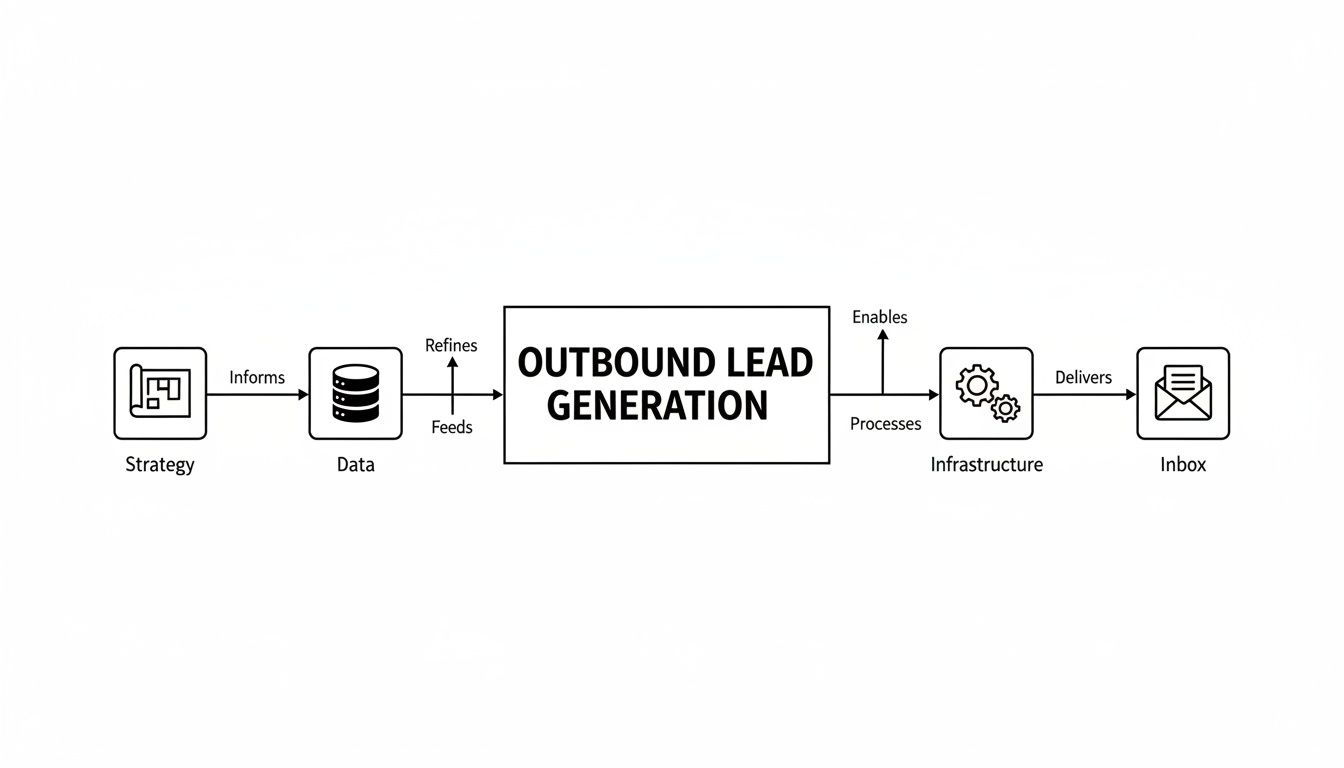
You can see how a solid strategy and clean data feed the technical infrastructure, which then powers the actual delivery of your message into the prospect's inbox.
Dedicated Sending Infrastructure
Imagine trying to run a global shipping operation by dropping all your packages in a public mailbox during the holidays. It's a recipe for disaster. A dedicated sending infrastructure is the equivalent of owning your own private fleet of delivery trucks—it guarantees your messages actually arrive.
The best outbound lead generation services build completely isolated technical environments. They aren't sharing software or, more importantly, IP addresses with any other company.
This separation is a deal-breaker. If your agency uses a shared system, your deliverability is held hostage by every other client they have. One careless client can get everyone on the shared IP blocklisted, instantly shutting down your entire pipeline.
This isn't a simple setup. It involves acquiring and methodically "warming up" hundreds—sometimes thousands—of unique domains and inboxes. This complex, ongoing process is what makes it possible to send campaigns at scale without landing in the spam folder, all while keeping your main business domain completely safe and sound.
Multi-Tiered Campaign Strategy
Let's be honest, not every prospect deserves the same level of attention. A generic, one-size-fits-all email blast is a fast track to mediocre results. A smart partner operates with a blended, multi-tiered approach that matches the outreach effort to the value of the account.
It typically breaks down like this:
- High-Volume Outreach: This is your broad-net approach. You target a wide segment of your Ideal Customer Profile to generate awareness and catch the low-hanging fruit. The messaging is less about deep personalization and more about hitting on universal industry pain points.
- Signal-Based Outreach: Here, you're targeting accounts that are actively showing signs of being in-market. Did they just get a new round of funding? Hire a new VP of Sales? A timely email referencing that specific "signal" makes your outreach feel incredibly relevant and well-timed.
- Hyper-Personalized Outreach: This is the white-glove treatment reserved for your "whale" accounts. It involves serious manual research. Every single message is crafted for a specific person, referencing their work, a company initiative, or something they recently posted about.
This layered system lets you cover the market efficiently while still dedicating the heavy-lifting of personalization where it will have the biggest impact on revenue.
Advanced Data Sourcing and Verification
Your outbound engine is only as good as the fuel you put in it, and in this world, that fuel is data. Basic company size and industry info just doesn't cut it anymore. High-performing teams dig much deeper, sourcing data that uncovers accounts that are a true fit and pinpoints the exact decision-makers.
This isn't about just buying one list. It means blending data from multiple providers and running it through proprietary verification processes to ensure it's accurate. Bad data—like stale email addresses or contacts who left their job six months ago—is a campaign killer. Top-tier services will guarantee over 95% data accuracy, ensuring your meticulously crafted messages actually reach a real person.
If you're looking to sharpen your own messaging, you can grab some proven ideas from these free cold email templates and adapt them to your own campaigns.
GTM-Focused Copywriting
The email itself is where all the strategy and data finally come together. Great outbound copy has nothing to do with flashy marketing slogans. It's about starting a real business conversation. The goal isn't to sell your product in the first email; it's to sell the meeting.
This demands copywriters who truly get your go-to-market (GTM) strategy. They know how to write messages that:
- Zero in on a problem: The copy quickly connects with a specific pain point that matters to the prospect's role and industry.
- Build instant credibility: It might offer a quick piece of social proof or a sharp insight that shows you know what you're talking about.
- Have a crystal-clear call-to-action: It makes saying "yes" to a quick chat feel easy and low-risk.
The best part? This copy is never static. It's constantly being tested and tweaked based on real-world performance data, optimizing everything from subject lines to the final CTA to drive up those reply rates.
Human-Powered Inbox Management
This is the final—and arguably most crucial—piece of the puzzle. The moment a prospect replies, all automation should stop. This is where human expertise must take over. A dedicated team of inbox managers should be on deck to handle replies, field initial questions, and navigate objections.
This human layer is what filters the signal from the noise. They triage all the incoming responses, clearing out the auto-replies and "not interested" emails. Then, they engage in quick, professional conversations with anyone who shows positive or even neutral interest.
An appointment only gets booked on your sales team's calendar after a prospect is confirmed to be a good fit and has explicitly agreed to a meeting. This is how you ensure your account executives spend their days closing deals, not sifting through unqualified leads.
How to Measure the True ROI of Outbound Services

It's easy to get lost in the weeds with outbound metrics. Open rates, reply rates, click-throughs… they're all interesting for diagnosing a campaign, but they don't tell you the one thing your board wants to know: is this making us money?
To get a real handle on the success of an outbound lead generation service, you have to stop looking at top-of-funnel activity and start measuring bottom-line results. Think of it this way: if you ran a pizza shop, you wouldn't measure success by how many people looked at your menu. You'd measure it by how many pizzas you sold. It's the same principle here.
Beyond Open Rates to Business-Critical KPIs
So, let's get down to the numbers that actually matter to your leadership team and investors. To see the true financial picture, you need to track the KPIs that directly connect outbound activity to your sales funnel.
These are the outcomes that prove your investment is paying off:
- Cost per Qualified Meeting: This is your first real gut check. Simply divide your total monthly spend on the service by the number of sales-qualified meetings they book. This tells you exactly what it costs to get one of your reps in a room (virtual or otherwise) with a legitimate buyer.
- Pipeline Generated: This is the total potential dollar value of all the sales opportunities that come from those meetings. It's a direct measure of how your outbound spend is fueling future growth and keeping your sales team fed.
- Closed-Won Revenue: The ultimate bottom line. This tracks the actual, hard revenue that you've closed from deals that started with your outbound partner. This is the "R" in your ROI calculation, plain and simple.
- Customer Lifetime Value (LTV) to Customer Acquisition Cost (CAC) Ratio: This gives you the long-term strategic view. By comparing what a customer is worth over their entire relationship with you to what it cost to acquire them, you see the true profitability of this channel. A healthy ratio here means you're building a sustainable business, not just chasing short-term wins.
When you consistently track these KPIs, you get a clear, undeniable picture of your outbound program's financial performance.
The real value of a top-tier outbound service isn't just in the meetings it books, but in the predictable flow of qualified pipeline it creates. This predictability is what allows you to confidently forecast revenue, make strategic hiring decisions, and scale your operations without guesswork.
Comparing B2B Lead Generation Channel Economics
Outbound isn't the only way to generate leads, and understanding the financial dynamics of different channels is key to building a balanced strategy. The table below provides a snapshot of the typical costs and conversion rates you might see, highlighting why so many B2B teams rely on a multi-channel approach.
| Channel | Typical Conversion Rate | Average Cost Per Lead | Key Advantage |
|---|---|---|---|
| Outbound Email/Calling | 1-3% (to meeting) | $200 - $600 | Highly targeted; builds direct relationships |
| Paid Search (PPC) | 2-5% (to lead form) | $50 - $150 | High-intent leads actively searching for solutions |
| Content/SEO | 1-3% (to subscriber/lead) | $20 - $80 | Builds long-term authority and attracts organic traffic |
| Webinars | 15-25% (registrant to lead) | $70 - $100 | Scalable education; positions you as an expert |
| Paid Social | 0.5-2% (to lead form) | $40 - $120 | Excellent for brand awareness and audience targeting |
As you can see, each channel has its own economic profile. While content and SEO might offer a lower cost per lead over time, outbound provides a direct, targeted path to high-value accounts that you might not otherwise reach. A strong outbound motion complements other channels, allowing you to be both proactive and reactive in your market.
Calculating the True Financial Impact
When you dig into the numbers, you start to see why a well-run outbound strategy is so compelling. The engine for most outbound lead generation services is email, and for good reason—its financial returns are massive. On average, email marketing can deliver a staggering $42 for every $1 spent, which is an ROI of 4,200%.
It's no surprise, then, that 89% of marketers lean on email as their primary channel for generating leads. The problem is, execution is everything. Shocking research reveals that only 20% of qualified leads ever receive proper follow-up. This is exactly the gap that a specialized service is designed to fill. You can dive deeper into these lead generation statistics and their impact on SalesHandy.
Let's walk through a real-world scenario. Your own data probably shows that your sales reps spend a huge chunk of their week—often around 28%—on manual prospecting instead of actually selling. When you outsource this, you aren't just buying meetings; you're buying back your team's most precious resource: time.
Here's how the math breaks down:
- Service Cost: You invest $10,000 per month in an outbound agency.
- Meetings Booked: They deliver 20 qualified meetings that month.
- Cost per Meeting: Your cost to get a rep in front of a buyer is $500.
- Pipeline Creation: Let's say 5 of those meetings convert into real sales opportunities, each with an average deal size of $50,000. You've just added $250,000 in new pipeline to your forecast.
- Closing the Deal: If your team closes just one of those deals, you've turned a $10,000 investment into $50,000 in revenue. That's a 5x return, right off the bat.
And this simple calculation doesn't even factor in the full lifetime value of that new customer or the massive efficiency gains you've given back to your internal sales team. When you start measuring outbound this way, it stops feeling like a cost center and becomes what it truly is: a powerful and predictable revenue engine.
The Future of Outbound Is Already Here
Forget the old stereotypes of outbound. The days of blasting out thousands of generic emails and hoping something sticks are officially over. By 2026, the game has completely changed.
Think about it like this: old-school outbound was like a fisherman casting a massive, indiscriminate net, hoping to catch a few of the right fish. Modern outbound lead generation services are more like marine biologists using sonar to find a specific school of fish, understanding their behavior, and then presenting the perfect bait. It's not about working harder; it's about being smarter and more precise.
AI-Powered Prospecting and True Personalization
The biggest leap forward comes from weaving artificial intelligence into the fabric of the entire process. Today's top-tier services use machine learning to sift through enormous amounts of data, identifying ideal customer profiles with an accuracy that was once pure science fiction. This goes so much deeper than just looking at a company's size or industry.
AI is now all about spotting "buying signals" in real-time. Imagine your outreach being automatically triggered the moment a target company:
- Closes a new round of funding.
- Hires a new VP in the department you sell to.
- Posts job descriptions that point to a new project or need.
- Adopts a piece of tech that integrates perfectly with your solution.
This is a complete game-changer. It allows you to engage a prospect at the exact moment they're most likely to need you, turning a "cold" email into a timely, helpful introduction. Just a few years ago, this kind of personalization at scale was impossible. Now, AI can help craft messages that reference these specific triggers, making every piece of outreach feel like it was researched and written just for them. To get this right, you can check out our guide on creating effective AI cold email prompts.
Instead of sending 10,000 generic emails and hoping for a 1% reply rate, the new model is to send 1,000 hyper-relevant messages that reference a specific event or need, driving a much higher rate of positive engagement. It's a fundamental shift from quantity to quality-driven outreach.
Intelligent Assistants and Winning the Speed-to-Lead Race
Another trend that's already here is the use of intelligent AI assistants to handle initial lead qualification and manage the inbox. These aren't the clunky chatbots of the past. They are sophisticated agents capable of understanding context, answering initial questions, and gauging a prospect's interest before a human sales rep ever steps in.
This has a massive impact on one of the most vital metrics in sales: speed-to-lead. An AI assistant can respond to an interested reply in seconds, 24/7. A human team, on the other hand, might take hours—or even a full day. That delay can be the difference between winning and losing a deal.
This isn't just theory; it's already delivering incredible results. Early data shows that AI-powered assistants are reshaping B2B lead capture, with 64% of companies using them reporting a tangible increase in qualified leads. This aligns perfectly with a broader focus on quality, as 73% of marketers now find that better lead nurturing creates warmer, more conversion-ready prospects. As you can see from these B2B lead generation trends on dwmedia.com, reducing response times from hours to seconds gives companies a serious competitive edge.
Ultimately, the future of outbound lead generation services is a marriage of deep data insights, AI-driven personalization, and smart automation. It ensures every single interaction is relevant and meaningful. The goal isn't just to book another meeting—it's to start a genuinely valuable conversation at the perfect time.
How to Choose the Right Outbound Partner
Picking the right outbound agency is a huge decision. Get it right, and you'll have a full pipeline. Get it wrong, and you'll burn through your budget with nothing to show for it. The market for outbound lead generation services is packed with providers all promising the moon. You need a simple, effective way to see who's for real.
Forget the slick sales decks and vague promises. You need to grill potential partners with the right questions. Think about it like hiring a key senior leader. You wouldn't just glance at their resume; you'd dig into their process, their tech stack, and their core philosophy to see if they're a true A-player.
Let's break down the five most important areas to scrutinize.
Infrastructure Ownership and Deliverability
The very first, most critical question you have to ask is: "Do you use dedicated or shared sending infrastructure?" This is a deal-breaker. A lot of agencies try to cut corners by lumping all their clients onto the same software and IP addresses.
That is a massive red flag. If another client on that shared system gets their emails flagged for spam, your campaigns sink right along with them. Your deliverability, and by extension your entire pipeline, is completely at the mercy of their worst client.
An elite partner will always build a completely isolated, dedicated sending infrastructure just for you. This means setting up hundreds of unique domains and inboxes that are carefully warmed up and managed exclusively for your company. It's the only real way to guarantee high deliverability and protect your brand's reputation when you're sending at scale.
Transparency and Reporting Cadence
Next, you need to get a clear picture of how they measure and report on what they're doing. Vague promises about "more leads" simply won't cut it. A partner you can trust will be an open book about the metrics they track and the cadence they report on.
Ask to see a sample report. Does it focus on fluff like open rates, or does it get down to real business outcomes?
A solid reporting process should always include:
- A live dashboard you can pop into anytime for a real-time pulse on campaign performance.
- Weekly or bi-weekly check-ins to go over the numbers, talk about what's working, and figure out the next steps.
- Clear tracking of bottom-line KPIs like Cost per Qualified Meeting, Pipeline Generated, and ultimately, Closed-Won Revenue that can be tied back to their work.
If an agency gets cagey about sharing details or their reports feel light on substance, it's a good sign they aren't confident they can deliver results that actually matter to your bottom line.
Scalability and Targeting Strategy
Your business is built to grow, and your outbound partner needs to be able to keep up. A critical part of the vetting process is understanding their game plan for scaling your campaigns without letting quality slip. Ask them straight up: "What's your strategy for expanding our reach once we've worked through the initial target list?"
If their only answer is "buy more data," that's not good enough. A sophisticated partner will describe a multi-layered approach. This might involve breaking into new market segments, using smart tools like a lookalike company finder to uncover similar accounts, or using signal-based targeting to find companies actively showing buyer intent.
Their ability to walk you through a clear, data-driven expansion plan is what separates a true strategic partner from a short-term campaign jockey.
Process and Team Structure
So, who's actually going to be managing your account and talking to your prospects? The human element is what makes or breaks a service like this. You need to pull back the curtain and understand the team and the process.
Ask these specific questions:
- Who is responsible for managing replies in our inboxes?
- Are they full-time employees of your company or outsourced freelancers?
- What are their hours of operation? (The best services offer 24/7 or near-24/7 coverage to jump on leads immediately).
The best outbound lead generation services have dedicated, in-house inbox managers who are deeply trained on your company, product, and market. This is the only way to ensure every interested prospect gets a fast, smart, and professional response—which is absolutely vital for turning that initial spark of interest into a booked meeting.
Pricing Model Alignment
Finally, let's talk about money. You need to have a very clear understanding of their pricing. There are a few common models out there, and the best one for you depends on your goals and how much risk you're willing to take on.
- Flat Retainer: You pay a fixed monthly fee. This is the most common model for comprehensive, full-service agencies.
- Pay-per-Lead/Meeting: You pay a set price for every qualified lead or meeting they book. This can sound great, but be careful—it can push the agency to focus on quantity over quality.
- Performance-Based: The fee is tied directly to results, like a percentage of revenue from closed deals. This creates the best alignment, but it's less common and often comes with a higher price tag.
Have an open conversation about these options. Your goal is to find a pricing structure where the agency's financial incentives are perfectly aligned with your own: generating real, measurable revenue. A partner who truly believes in their ability to perform will have a pricing model that reflects that confidence.
Your Top Outbound Questions, Answered
When you're thinking about bringing in an outside partner for outbound, a few practical questions always come to the surface. Let's get straight to the answers you're looking for.
What Do These Services Typically Cost?
Let's talk money. Pricing for outbound lead generation services isn't one-size-fits-all, and you'll usually see one of three models.
- Flat Monthly Retainer: This is the go-to for full-service partners who handle everything from strategy and list-building to writing copy and managing your reps' inboxes. For a comprehensive program, you can expect to invest several thousand dollars a month.
- Pay-Per-Lead or Meeting: Here, you pay a set price for each qualified lead or meeting that gets booked. It sounds appealingly straightforward, but you have to be vigilant about lead quality.
- Performance-Based: With this model, the agency's fee is tied directly to results, like a percentage of the revenue from deals they sourced. It creates great alignment, but be prepared for a higher potential cost if the program is successful.
How Long Until We See Real Results?
This is the big one. While you might see some encouraging signs like high open rates in the first 30 days, getting to a predictable flow of qualified meetings realistically takes 60 to 90 days.
That initial ramp-up period is absolutely critical. It's when the technical groundwork is laid, domains are warmed up, and your partner is rigorously testing messages to see what truly resonates with your ideal customers.
Think of it like this: you can't plant a seed today and expect to have a full-blown harvest tomorrow. Those first 90 days are for tilling the soil and nurturing the roots. It's the only way to build a pipeline that delivers sustainable growth, not just a few quick wins.
Will an Agency Replace My Sales Team?
Not at all. In fact, it's the opposite. Most B2B companies use outbound lead generation services to make their internal team more effective, not to replace them.
The agency takes on the heavy lifting—the time-consuming, top-of-funnel prospecting that needs to be done at scale. This frees up your in-house SDRs or AEs to focus on what they do best: building relationships, running great discovery calls, and managing the qualified meetings the service books for them. Your whole sales function just gets more focused and efficient.
Ready to turn outbound into your most predictable revenue channel? RevoGTM builds and manages a complete, done-for-you prospecting engine that puts qualified meetings on your calendar. Learn how we scale your pipeline.
Want results like this for your business?
We build the cold email infrastructure that books qualified meetings on autopilot.
Book a CallMore from the blog
Top LinkedIn Marketing Agencies for B2B SaaS Growth
Tired of generic advice? Find, vet, and manage top LinkedIn marketing agencies delivering qualified meetings at scale for B2B SaaS revenue teams.
closing statements for emails8 B2B Closing Statements for Emails That Get Replies (2026)
Stop using 'Best regards.' Discover 8 expert-approved closing statements for emails in B2B, with templates for cold outreach, follow-ups, and more.
what is an inside sales representativeWhat Is an Inside Sales Representative: A 2026 Guide
Understand what is an inside sales representative in 2026. Learn about their role, essential skills, key metrics, & how to scale for predictable revenue.