
How to Get Clients for Consulting: A Modern Playbook
If you're eager to learn how to get clients for your consulting business, your first instinct might be to jump straight into outreach. But hold on. The most successful consultants I know don't start there. They first build a magnetic foundation that does the heavy lifting for them.
If you're eager to learn how to get clients for your consulting business, your first instinct might be to jump straight into outreach. But hold on. The most successful consultants I know don't start there. They first build a magnetic foundation that does the heavy lifting for them.
It's all about making a crucial shift from being a generalist to becoming a recognized specialist. When you nail your niche, clarify your value, and create offers your ideal clients can't refuse, they'll start seeing you as the only logical choice.
Building Your Foundation to Attract High-Value Clients

Before you write a single email or ask for one referral, you have to get brutally honest and answer a simple question: "Who, specifically, do I help, and what painful problem do I solve for them?"
Without that clarity, your marketing will feel like shouting into a void. I've seen it happen countless times. The consultants who consistently land high-ticket clients aren't just smart; they're specialists who've built their business on an unshakable foundation. This really comes down to three things: defining your niche, nailing your value proposition, and packaging your services.
Carve Out Your Profitable Niche
Let's be real: calling yourself a "business consultant" is a death sentence. It's far too broad. You become a commodity, stuck competing on price against a sea of other generalists. The goal is to become the go-to expert for a very specific type of person with a very specific—and expensive—problem.
Think about a marketing consultant. Instead of just offering "marketing services," imagine they positioned themselves as a "lead generation expert for B2B SaaS companies struggling to scale past $5M ARR." See the difference? That specificity instantly screams expertise and filters out anyone who isn't a perfect fit.
Your sweet spot is usually at the intersection of your experience, what the market actually needs, and—just as important—what you enjoy doing.
To dial in your niche, ask yourself:
- What industry do I know inside and out? (e.g., fintech, healthcare IT, D2C e-commerce)
- What size company do I serve best? (e.g., scrappy startups, mid-market companies, large enterprises)
- What specific, expensive problem am I uniquely qualified to solve? (e.g., reducing customer churn, improving sales team close rates, navigating complex regulatory changes)
Once you have a tight niche, finding your ideal clients becomes a whole lot easier. You can even use tools like a lookalike company finder to build a laser-focused list of prospects that mirror your best clients.
Articulate Your Compelling Value Proposition
With your niche defined, you need a powerful value proposition. This is just a clear, punchy statement explaining the tangible results a client gets by hiring you. It's not about the tasks you perform; it's about the outcome you deliver.
A weak value proposition is: "I offer financial consulting services."
A strong one is: "I help self-funded SaaS founders become profitable within 12 months by optimizing their pricing strategy and cash flow."
The second one hits different, right? It speaks directly to a specific person (self-funded SaaS founder) and promises a clear, highly desirable result (profitability in 12 months). It connects directly to their pain, making your service feel like a must-have, not a nice-to-have.
Package Your Services into Irresistible Offers
Finally, please, stop selling your time by the hour. It's the fastest way to cap your income and devalue your expertise. Instead, package what you know into clear, outcome-driven offers. This immediately shifts the client's focus from cost to investment, giving them a predictable result for a fixed price.
Here are a few package structures that work incredibly well:
- The Diagnostic/Audit: This is a one-time, fixed-fee project where you analyze a specific problem and deliver a strategic roadmap. Think of it as a "Cybersecurity Threat Assessment" for a small law firm. It's a low-risk entry point for new clients.
- The Project-Based Engagement: A clearly defined scope of work with a start date, end date, and a specific set of deliverables. For example, "Implementing a HubSpot CRM and training a 20-person sales team." The client knows exactly what they're getting.
- The Monthly Retainer: Perfect for clients who need ongoing support and execution. You provide continuous guidance for a fixed monthly fee, acting as their "Outsourced CMO" or "Fractional CFO."
Get this foundation right, and you'll completely change the game for your consulting practice. You'll attract better clients, charge the fees you deserve, and make every other client acquisition tactic you use ten times more effective.
Mastering Inbound Strategies for Warm Leads
Once you've nailed down your positioning, it's time to stop hunting for clients and build a system that brings them to you. This is the whole point of inbound marketing—creating a magnet for prospects who are already looking for your help.
When you do this right, you're not just getting leads. You're attracting people who are already partially sold on your value before you even have a conversation. It's about engineering a reliable flow of opportunities, which dramatically shortens your sales cycle because the trust-building has already begun.
Building a Systematic Referral Engine
For most consultants, referrals are the lifeblood of their business, yet they treat them like a happy accident. A study found that while a staggering 60% of consulting work comes from referrals, it's one of the least prioritized activities. Let's change that from a hope to a system.
Instead of just dropping a generic, "Do you know anyone?" at the end of a project, you need a repeatable process.
- Proactive Check-ins: Don't just disappear after the final invoice is paid. Schedule a quick, quarterly check-in with your best past clients. The goal isn't to ask for anything; just offer a small piece of advice or share an interesting article. This keeps you top of mind.
- The "Ideal Client" Conversation: During these chats, get specific about who you're helping now. For instance, say something like, "Lately, I've been doing a lot of work with Series B fintechs struggling to reduce first-month churn in their onboarding." This gives your contact a clear trigger to recognize a potential referral.
- Make It Easy: Nobody wants to do the work for you. Create a simple one-pager or a concise email template they can easily forward. It should clearly outline the problem you solve, for whom, and the typical results you deliver.
This simple shift transforms referrals from a random bonus into a predictable, measurable channel. You're not just asking for favors; you're equipping your network to be an extension of your sales team.
Create Content That Captures Leads
Content marketing for consultants isn't about chasing viral trends on social media. It's about producing high-value assets that prove you know what you're talking about and directly support your client acquisition goals. Think of your content as your best salesperson, working 24/7.
The most effective consulting content doesn't just inform; it diagnoses a problem and implicitly positions your service as the cure. It makes the reader think, "This person truly understands my situation."
Focus on a handful of key formats that scream "expert" and showcase your problem-solving chops:
- High-Impact Case Studies: Go way beyond the boring "challenge-solution-result" format. Tell a compelling story. Detail the "before" state with specific pain points, walk through your diagnostic process, and most importantly, quantify the "after" with hard numbers. This is your most powerful sales collateral.
- Insightful White Papers: Tackle a single, significant problem that your ideal clients are losing sleep over. A paper titled "A Framework for Slashing CAC in Enterprise SaaS" is infinitely more compelling than a generic blog post. Use it as a lead magnet on your site to capture contact info.
- Targeted Webinars: Host a live or on-demand webinar addressing a pressing issue in your niche. This is your chance to shine, demonstrate your expertise in real-time, and engage directly with potential clients. Always record it and use it as an evergreen asset.
These inbound methods typically have a much lower client acquisition cost. With the average Customer Acquisition Cost (CAC) for consulting firms hovering around $533, finding more efficient channels is absolutely critical for your bottom line.
Turn Your LinkedIn Profile into a Client Magnet
Your LinkedIn profile is not a resume; it's a sales page. Most consultants get this completely wrong. They fill it with past job duties instead of focusing on the problems they solve for their future clients.
Start with your headline. Ditch "Management Consultant at XYZ Firm" for something that grabs attention, like: "I Help Manufacturing Leaders Slash Operational Waste by 20% | Fractional COO | Process Optimization Expert." This immediately tells a visitor what you can do for them.
Next, use your "Featured" section as your highlight reel. Post your best case study, that webinar recording, or your most downloaded white paper. Then, rewrite your "About" section to speak directly to your ideal client's pain points before you even introduce yourself.
Of course, once these leads start coming in, you need a way to track them. This is where a simple CRM comes in handy. By building these simple inbound systems, you create a powerful and sustainable engine for growing your consulting practice.
Proactive Outbound: Taking Control of Your Pipeline
Relying on referrals and inbound leads is a great way to start, but it puts you in the passenger seat of your own business. You're essentially waiting for the phone to ring. To build a truly predictable consulting pipeline, you have to take control. That's where proactive outbound comes in.
This isn't about blasting out generic templates and hoping for the best. It's about systematically starting one-on-one conversations with the exact people you want to work with, ensuring your calendar stays booked with qualified prospects.
Build Your Hit List, Not a Mass Mailing List
The success of any outbound effort hinges entirely on who you're contacting. Spray-and-pray is a waste of time and burns your reputation. Your real goal is to meticulously build a "hit list" of prospects who are a perfect fit for what you do.
Get granular here. Go way beyond just their industry or company size.
- Job Titles: Pinpoint the person who actually feels the pain you solve and holds the budget. Is it the "VP of Marketing," the "Head of Product," or the "COO"?
- Company Stage: A Series A startup struggling to find product-market fit has entirely different problems than a stable, mid-market company looking to optimize. Who do you serve best?
- Buying Signals: Look for triggers that signal an immediate need. A recent funding announcement, a wave of new hires in a specific department, or even a public mention of a new strategic challenge are all green lights.
This is where a tool like LinkedIn Sales Navigator becomes your best friend. It lets you filter the entire professional world down to a small, highly-relevant list of people who need to hear from you.
Crafting Messages That Actually Get Read
Your prospect's inbox is a warzone. To stand out, your message has to immediately scream, "This was written specifically for you." The formula is simple but powerful: Relevance + Value.
Lead with a hyper-personalized hook that proves you've done your homework. This is more than just a mail merge.
I saw your recent LinkedIn post on the growing pains of scaling your engineering team past 20 developers. It's a common ceiling I helped [Similar Company] break through by implementing a new pod-based structure.
An opener like that instantly builds credibility and shows you understand their world. From there, pivot quickly to the value you provide, but frame it around their potential outcome, not your process. Keep it short, focused, and end with a soft, low-friction call-to-action. You're just asking to explore an idea, not for a 60-minute demo.
If you're looking for proven frameworks to get started, you can find some free cold email templates designed for consultants and tweak them for your own niche. The goal is to make every email feel like a personal note.
The Power of Strategic Partnerships
Another outbound channel that acts as a massive force multiplier is strategic partnerships. Find other non-competing businesses who serve the exact same clients you do, and you can create a powerful, consistent stream of warm referrals.
Think about who your ideal client pays right before or right after they need you.
- A fractional CMO could partner with a branding agency.
- An IT security consultant might team up with a managed service provider (MSP).
- A sales operations consultant could build a relationship with a CRM implementation firm.
It has to be a two-way street. You send them good-fit leads, and they do the same for you. When you approach a potential partner, come with a clear pitch that explains how your services complement theirs and, most importantly, how the collaboration will add value for their clients.
The opportunity here is enormous. The U.S. consulting market saw a 5.4% compound annual growth rate between 2020 and 2025, expanding to nearly 1 million firms and a $407.3 billion market size. With so many specialized players, finding a perfect partner is more achievable than ever.
Client Acquisition Channel Comparison
Choosing where to invest your time and money is critical. Some channels are cheap but time-consuming, while others scale beautifully but require more upfront investment. This table breaks down the common options for consultants.
| Channel | Average CAC | Effort to Implement | Scalability Potential |
|---|---|---|---|
| Referrals | Very Low | Low | Low |
| Content & SEO | Low to Medium | High | Medium |
| Cold Outreach | Medium | Medium | High |
| Strategic Partners | Low | Medium | Medium |
| Paid Ads (LinkedIn) | High | Medium | High |
As you can see, there's no single "best" channel. A healthy consulting practice usually blends a few of these, like using cold outreach to fill gaps while long-term content strategies take root.
Follow Up Without Being a Pest
Most consulting engagements aren't closed on the first touch. The real magic often happens in the follow-up, but there's a fine line between persistence and annoyance. The key is to add value with every single interaction.
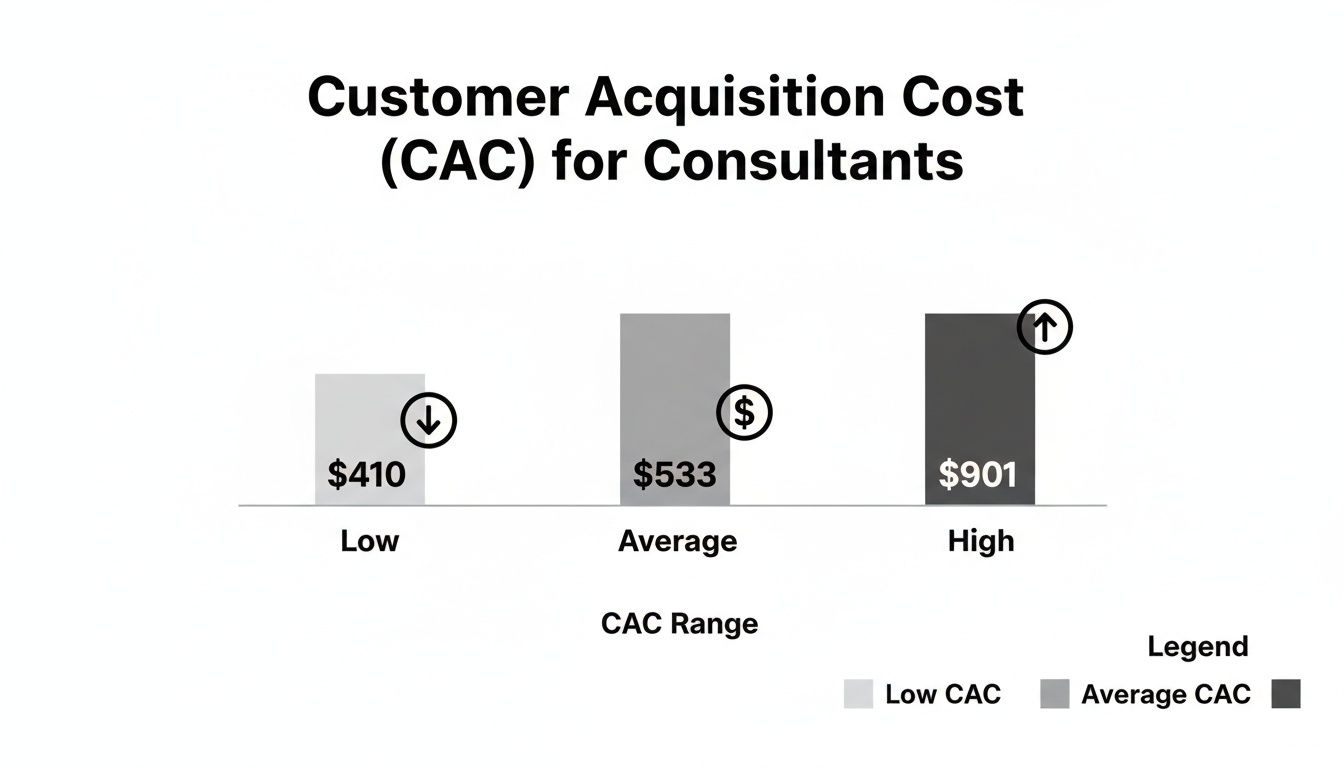
As the chart shows, the average Customer Acquisition Cost (CAC) for a consultant is around $533, but it can swing from $410 to $901. Your follow-up efficiency is a huge factor in keeping your CAC on the lower end of that spectrum.
Instead of the dreaded "just checking in" email, try a value-add sequence.
- Email 1: The initial, personalized outreach.
- Email 2 (3 days later): Send a link to a relevant article or a short case study. "Thought you might find this interesting given your focus on..."
- Email 3 (5 days later): Reference a company win or recent news, and tie it back to your original point.
- Email 4 (7 days later): The "breakup" email. Politely close the loop but leave the door open for the future.
This approach positions you as a helpful expert, not a pushy salesperson. By combining a laser-focused list, truly personal messaging, and a value-driven follow-up system, you build a repeatable engine that keeps your pipeline full and your business growing on your terms.
Turning Conversations into Consulting Contracts

Getting a meeting on the calendar is a great first step, but it's just that—a first step. The real test of a consultant is turning that initial chat into a signed contract. This is where the magic happens, and it all starts with how you handle the discovery call.
So many consultants get this wrong. They show up ready to pitch, talking at the prospect about how great they are. That's a huge mistake. Your only job on that first call is to listen and diagnose. You want them to walk away thinking of you as a strategic partner, not just another vendor trying to sell them something.
Mastering the Diagnostic Discovery Call
Think of the discovery call less like an interview and more like a doctor's appointment. You're not there to rattle off your services. You're there to dig deep, uncover the root cause of their business pain, and figure out just how much it's costing them.
The trick is to ask questions that go a layer or two deeper than the surface stuff.
- Start with the obvious: "What's the biggest challenge you're facing right now?"
- Then, dig a little: "That's interesting. What have you already tried to fix this, and what were the results?"
- And finally, hit the impact: "If this problem isn't solved in the next six months, what's the real financial or operational impact on the business?"
This line of questioning completely changes the conversation. You stop being a salesperson and start co-creating a business case for change with them.
Qualify Hard So You Can Close Easy
Let's be honest: not every prospect who wants to talk to you is a good fit. In fact, a lot of them won't be. One of the biggest time-wasters for new consultants is chasing down leads that were never going to close in the first place. Your time is your inventory, so you have to protect it fiercely.
A simple qualification framework can save you hundreds of hours of wasted effort. Before you even think about writing a proposal, make sure the prospect checks a few key boxes.
A study of over 50,000 consultants found that 42% struggle more with sales—actually converting prospects into clients—than with marketing. Proper qualification is your first line of defense, making sure you only spend time on deals you have a real shot at winning.
A classic for a reason, the BANT framework works wonders:
- Budget: Do they actually have money set aside to solve this?
- Authority: Are you talking to the person who can sign the check, or just an influencer?
- Need: Is this a genuine, "hair-on-fire" problem, or just a nice-to-have?
- Timeline: Do they need to solve this now, or is it a vague "sometime next year" thing?
If you get a 'no' on one or more of these, they aren't qualified. That's okay! You can send them some helpful resources and offer to check back in a few months, but don't move them to the proposal stage. This discipline is what separates busy consultants from profitable ones.
Crafting Proposals That Win Deals
A great proposal isn't a long, boring document about you and your background. It's a sales tool. Its job is to echo the pain you uncovered in the discovery call and position your solution as the clearest, most logical path forward. It should feel like a summary of the conversation you just had.
Here's a simple, client-focused structure I've personally used to close six-figure deals:
- Here's Where You Are: Start by restating their problem and its consequences, using their own words. It proves you were paying attention.
- Here's Where You Want to Be: Paint a vivid picture of their "desired future state." What does life look like after this problem is gone?
- Here's How We'll Get You There: Detail the exact deliverables and milestones. Be crystal clear about what's included and, just as importantly, what's not.
- Your Investment: Clearly state the project fee. If you can, frame it against the potential return on investment you discussed.
- Our Next Step: Make it incredibly easy to say yes. Tell them exactly what to do next, whether it's signing the document or scheduling a quick final call.
This approach turns your proposal from a price list into a strategic blueprint. It shows you get their business on a fundamental level. By mastering discovery, qualifying ruthlessly, and writing value-first proposals, you build a repeatable system that turns promising conversations into paid contracts.
Knowing When to Scale Your Client Acquisition
As your consulting business picks up steam, you'll eventually hit a wall. It's a great problem to have, but it's a problem nonetheless. Your calendar is packed with client work, but it's also clogged with the never-ending cycle of prospecting, emailing, and following up.
This is the point where managing client acquisition yourself goes from being a core task to the single biggest bottleneck holding back your growth. The question isn't if you should scale your outreach, but when. The signs are usually obvious: you're consistently booked solid, you find yourself turning down good projects, and every hour spent hunting for the next client is an hour you can't bill. This is your cue to start thinking like a CEO and delegate.
Calculating the Tipping Point
Deciding when to delegate really just comes down to some simple math. First, you need to get real about the value of your own time.
If you bill at $200 per hour, every single hour you spend on manual prospecting has an opportunity cost of $200. Let's say you spend a conservative 10 hours a week finding leads. That's $8,000 a month in lost billable time.
Suddenly, paying for a specialized service doesn't feel like a cost anymore—it looks like a savvy investment. When the price of a dedicated growth partner is less than the revenue you're leaving on the table by doing it all yourself, you've found your tipping point. It's time to grow beyond your own two hands.
A critical mistake I see even the most successful consultants make is viewing this kind of scaling as an expense. It's not. The goal isn't just to buy back your time; it's to build a predictable revenue machine that runs without your constant, direct involvement.
This shift in thinking is what takes you from being an operator in your business to an owner working on your business.
The Advantages of a Growth Partner
Bringing on a specialized team like RevoGTM isn't just about outsourcing a few email sends. You're essentially buying a fully operational, high-performance prospecting engine from day one. This completely changes the game when you're trying to figure out how to get clients for consulting in a more systematic way.
Here are the core advantages you get right away:
- Dedicated Sending Infrastructure: Most consultants are sending outreach from their own email account, which has serious limitations. A real partner runs on isolated, high-volume infrastructure built from the ground up for one thing: deliverability. This means your messages actually land in the primary inbox, not spam.
- High-Volume, Scalable Outreach: You might be able to send a few dozen personalized emails a week. A dedicated service can deploy thousands. This massively expands your reach and fills your pipeline faster than you could ever manage on your own.
- A Team of Inbox Managers: This is the most valuable piece of the puzzle. Instead of you personally sifting through every reply, a team of trained professionals monitors your inbox around the clock. They qualify leads, handle initial objections, and book meetings directly on your calendar.
The end result? You only step in when a prospect is qualified, interested, and ready for a real conversation. All the tedious, time-sucking work of finding and nurturing leads is handled for you. This frees you up to focus on the two things that actually grow your business: closing deals and delivering exceptional work.
What to Look For in a Partner
Be warned: not all outbound services are created equal. When you're ready to make this leap, finding the right partner is everything. You need much more than a scraped list and a few generic templates.
Look for a partner who can deliver on these key things:
- Guaranteed Deliverability: Ask them hard questions about their infrastructure. Do they own it? Is it isolated from other clients? This technical foundation is non-negotiable for any successful campaign.
- Scalable Systems: Can they support a sophisticated approach? You want a partner who can blend high-volume outreach with hyper-personalized sequences for your absolute dream clients.
- Human-Powered Management: Is a real person managing replies, or is it all bots? Full automation feels robotic and misses the nuance and opportunities that only a human touch can capture.
Making this move is how you finally break through the solo consultant's income ceiling. It's the strategic transition from being a self-employed individual to becoming the leader of a growing enterprise.
Common Questions I Hear About Landing Consulting Clients
As you start building your consulting practice, a handful of questions inevitably pop up again and again. It's completely normal. Let's tackle some of the big ones I hear most often from consultants trying to build a predictable client pipeline.
How Many Clients Do I Actually Need?
I get this question all the time, and the honest answer is: it depends entirely on your goals. There's no magic number, but you can figure out your own with some simple math.
Start with your target annual revenue. Now, divide that by what you charge per project or what a client is worth over their lifetime with you. For example, a strategy consultant charging $100,000 for a single, high-impact project might only need 3-5 clients a year to have a fantastic business. On the other hand, if your model is a $5,000 monthly retainer, you'll likely need 15-20 active clients to hit a similar revenue target.
The real bottleneck is almost always your personal capacity. It's far better to deliver exceptional results for a few great clients than to be spread so thin that you're only providing mediocre service to a dozen. Your reputation is your most valuable asset—protect it.
What's the Fastest Way to Get My First Consulting Client?
The quickest, most reliable path to your first few paying clients is almost always through your own network. These are people who already have a foundation of trust with you.
Think about former colleagues, bosses you respected, and other professional contacts. When you reach out, don't just send a generic "I'm a consultant now, have any work?" message. Be specific. Tell them exactly what problems you solve and who you solve them for. This arms them with the information they need to send the right referrals your way.
If you want a more predictable and scalable approach from day one, targeted outbound is your best bet. A well-researched, personalized campaign on LinkedIn or via cold email can start booking meetings in a matter of weeks. While things like content and SEO are incredible for long-term growth, direct outreach gets you the immediate conversations and feedback you need to get off the ground.
How Much Should I Budget to Acquire a New Client?
You need to stop thinking of your client acquisition budget as an "expense" and start seeing it for what it is: an investment. The crucial metric here isn't just the cost itself, but how that cost measures up against your client's Lifetime Value (LTV).
For most B2B consulting services, a healthy LTV to Customer Acquisition Cost (CAC) ratio is 3:1 or even higher. Let's make that real. If your average client engagement brings in $30,000 in revenue, spending up to $10,000 to land that client is a smart, profitable business decision.
The key is to meticulously track your sales and marketing spend and attribute it to the new clients you win. This will give you a clear CAC for each channel, showing you exactly where to double down on your investment for the best returns.
Ready to stop spending your valuable time prospecting and start focusing only on closing deals? RevoGTM delivers a fully managed outbound engine that books qualified meetings directly on your calendar. See how we build a predictable revenue machine for consultants.
Want results like this for your business?
We build the cold email infrastructure that books qualified meetings on autopilot.
Book a CallMore from the blog
Top LinkedIn Marketing Agencies for B2B SaaS Growth
Tired of generic advice? Find, vet, and manage top LinkedIn marketing agencies delivering qualified meetings at scale for B2B SaaS revenue teams.
closing statements for emails8 B2B Closing Statements for Emails That Get Replies (2026)
Stop using 'Best regards.' Discover 8 expert-approved closing statements for emails in B2B, with templates for cold outreach, follow-ups, and more.
what is an inside sales representativeWhat Is an Inside Sales Representative: A 2026 Guide
Understand what is an inside sales representative in 2026. Learn about their role, essential skills, key metrics, & how to scale for predictable revenue.