
Difference Between Inside Sales and Outside Sales Explained
At its heart, the distinction between inside sales and outside sales boils down to a single, critical factor: location. This isn't just a matter of geography; it fundamentally shapes every aspect of the sales function, from daily workflows and cost structures to the very nature of the customer relationships you build.
At its heart, the distinction between inside sales and outside sales boils down to a single, critical factor: location. Inside sales professionals operate remotely—from an office or home—using phones, email, and video calls to connect with prospects. In contrast, outside sales reps are on the ground, meeting customers face-to-face.
This isn't just a matter of geography; it fundamentally shapes every aspect of the sales function, from daily workflows and cost structures to the very nature of the customer relationships you build.
Inside Sales vs Outside Sales A High-Level Comparison
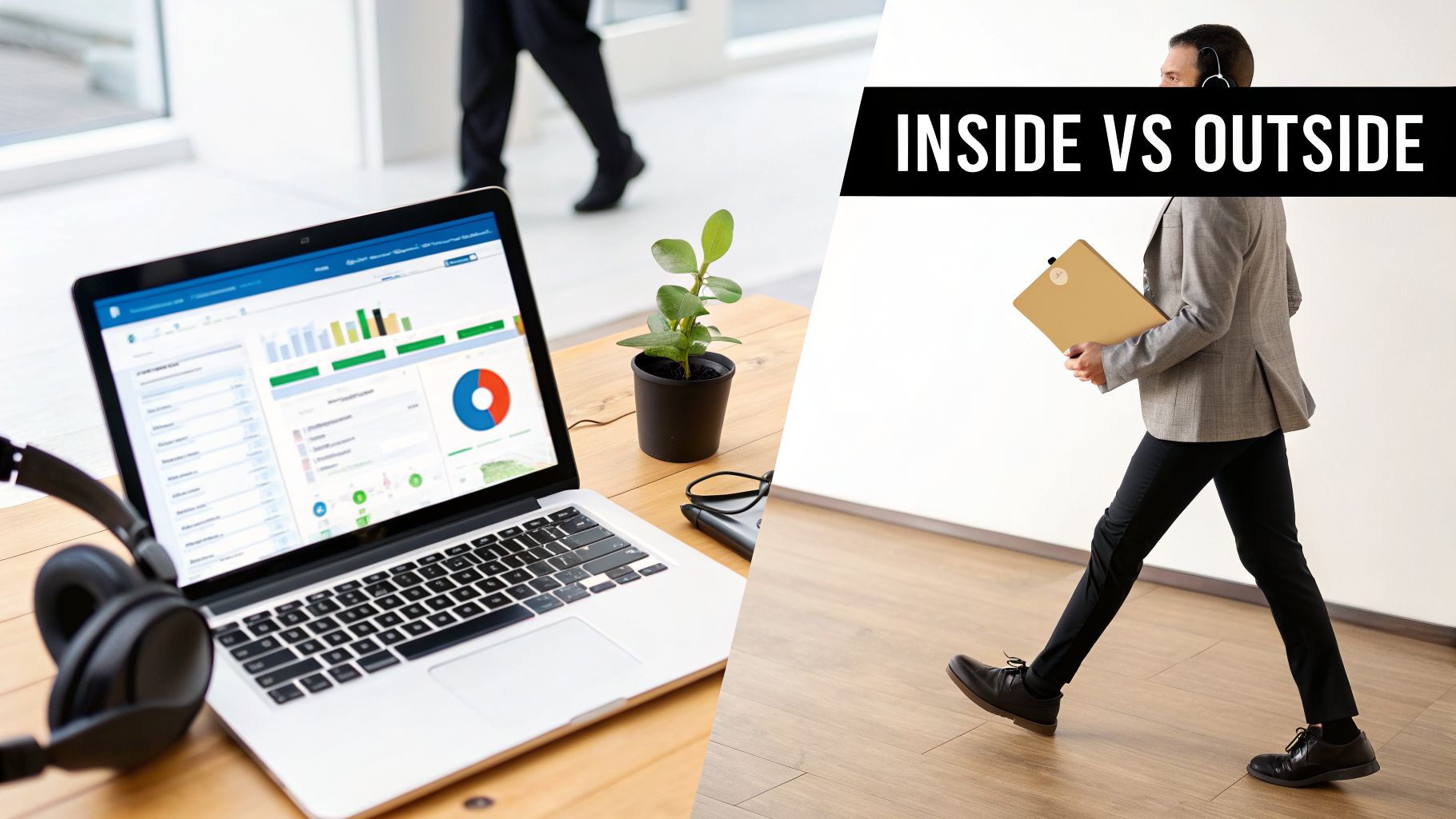
While location is the most obvious difference, the strategic implications go much deeper. An inside sales engine is built for speed, volume, and efficiency. It's the perfect model for products with shorter sales cycles and more transactional price points, relying on repeatable processes and a robust tech stack to manage a high volume of prospect interactions every day.
Outside sales, often called field sales, is designed for something else entirely: depth, complexity, and high-value relationships. These reps travel to meet clients, build trust through personal connection, and navigate complicated deals that often involve multiple stakeholders and much longer buying cycles.
For any B2B leader aiming to build a scalable go-to-market strategy, understanding these foundational models is the first step. The decision to go with one, the other, or a hybrid approach has a direct ripple effect on hiring, technology investments, and your overall customer acquisition cost.
Key Differences at a Glance Inside Sales vs Outside Sales
To make the comparison crystal clear, here's a breakdown of how the two models stack up across the most important business functions.
| Aspect | Inside Sales | Outside Sales |
|---|---|---|
| Primary Location | Office or remote | In the field, traveling |
| Engagement | Digital (phone, email, video) | In-person (meetings, events) |
| Sales Cycle | Shorter (weeks to months) | Longer (months to years) |
| Average Deal Size | Lower to moderate | Higher, often enterprise-level |
| Cost of Sale | Lower; minimal travel | Higher; includes travel costs |
| Scalability | High; easy to add reps | Lower; requires territory planning |
| Focus | Transactional velocity, volume | Relational depth, strategic value |
This table gives you a great snapshot, but the real insights come from digging into how these differences actually impact your day-to-day operations, team design, and long-term planning.
A Look at the Daily Grind in Each Sales Role

To really get the difference between inside and outside sales, you have to picture what a typical day looks like for each. The daily realities for these reps couldn't be more different, each shaped by its own cadence, tools, and pressures. Looking at their day-to-day gives you a clear sense of the skills needed for each model and what to look for when you're hiring.
An inside sales rep's day is a sprint—a highly structured, high-activity race against the clock. It's a job heavily dependent on metrics and tech, where success is often measured by the sheer volume of daily touchpoints. This world is perfect for people who thrive on process and are comfortable working within a well-defined system.
On the flip side, an outside sales rep's day is a marathon of autonomy and strategic planning. Their office is a car, an airport, or a client's conference room. This path attracts self-starters who are masters of their own schedule, adept at navigating large territories, and skilled at building deep, lasting trust through face-to-face interactions.
A Day in the Life of an Inside Sales Rep
The inside sales pro is glued to their tech stack. Their day doesn't start with a commute; it starts with logging into a CRM, a sales engagement platform, and a dialer. Their environment is all about controlled speed, pushing a high volume of leads through a structured sales process as efficiently as possible.
A typical day is packed with activity:
- Structured Call Blocks: Hammering out 50–80 dials to qualify new leads and nudge existing opportunities forward.
- Digital Demos: Jumping from one virtual product demo to the next, using screen sharing to showcase value without ever leaving the office.
- Email Cadence Management: Juggling dozens of prospects at once with a smart mix of automated sequences and personalized follow-ups.
- Data-Driven Adjustments: Using analytics to see what's working. They're constantly analyzing call recordings and email engagement to tweak their pitch.
The heart of an inside sales rep's day is the playbook. They live and die by their ability to execute a high-volume, repeatable process. Hitting aggressive monthly targets depends on their consistency and speed.
A Day in the Life of an Outside Sales Rep
The outside sales professional operates with a ton of independence. Their day is less about the number of calls and more about the strategic care of a few high-value accounts. Their work is a blend of meticulous planning, constant travel, and the subtle art of in-person persuasion.
Their schedule is dictated by geography and their clients' calendars:
- Territory Planning: Mapping out the most efficient travel routes to maximize face time with key accounts across a city, state, or even the country.
- On-Site Meetings: Hitting the road to deliver executive-level presentations, conduct deep discovery sessions, and navigate complex negotiations in the client's own office.
- Relationship Building: Cementing partnerships over lunch or at industry trade shows, where a personal connection can make or break a deal.
- Strategic Account Deep Dives: Pouring hours into researching a single client's business to prepare for a major, long-term opportunity.
The daily routines lay the core difference bare. One role is built for scalable, tech-driven efficiency. The other is designed for deep, personal engagement and strategic relationship management.
Comparing Strategic Sales Playbooks and Workflows
How your sales team operates day-to-day looks completely different depending on whether they're working from the inside or out in the field. The playbooks and workflows for inside and outside sales are built for opposing goals: one prioritizes speed, the other strategic depth.
The inside sales playbook is all about creating a highly structured, repeatable system that can handle a massive volume of leads. Think of it as a finely-tuned engine designed for velocity. Every step is measured and optimized to make the process as efficient as possible, allowing a single rep to juggle dozens of conversations every single day. This model is a perfect fit for products with shorter sales cycles and lower price points, where the name of the game is reaching more people, faster.
On the flip side, the outside sales workflow is a strategic, long-game approach. It revolves around meticulous account planning and navigating the complex, often political, landscape of large buyer organizations. Here, it's not about the daily call count but about the quality of engagement with a handful of high-value accounts.
The Inside Sales Playbook: Speed and Repeatability
An inside sales playbook is built on a foundation of structure, scripts, and automation. It's a scientific approach, really, designed to let teams scale up quickly while keeping the message consistent across every single prospect interaction.
You'll almost always find these components:
- Structured Cadences: These are multi-channel, multi-touch sequences that map out every follow-up. A typical cadence might lay out a specific pattern of calls, emails, and LinkedIn touches over two weeks, with most of it automated through a sales engagement tool.
- Templated Messaging: Personalization is still key, but inside sales relies on proven email templates and call scripts to make sure the core value proposition hits home every time. For a deep dive, check out our guide on creating effective cold email templates.
- CRM-Driven Workflows: The CRM acts as the team's brain. Automated triggers move leads through the pipeline, assign tasks, and log every activity. This minimizes manual data entry and makes sure no lead ever falls through the cracks.
The whole system is built for high-throughput activity. It's not unusual for an inside sales rep to work through 40-60 prospects a day, jumping from a discovery call to a product demo to a proposal follow-up, all from their desk.
The Outside Sales Workflow: Depth and Strategic Planning
The workflow for an outside seller is far more fluid and customized. It's less like an assembly line and more like managing a series of high-stakes strategic projects. Success isn't measured in calls per day but in the meaningful progress made within a target account over months—or even years.
This approach is defined by its focus on:
- Meticulous Account Planning: Reps invest serious time researching an organization's internal structure, identifying the key players, and understanding their business challenges. This deep dive informs a completely custom engagement plan for that one account.
- Navigating Buyer Committees: Outside sales is a masterclass in organizational politics. The job involves finding internal champions, winning over skeptics, and building consensus across multiple departments, from IT and finance to legal and the C-suite.
- In-Person Engagement: The heart of the workflow is face-to-face connection. These aren't just quick demos; they're often multi-day workshops, on-site executive reviews, and intense negotiations designed to build unshakable trust.
The crucial difference between inside sales and outside sales is what each motion optimizes for. Inside sales optimizes for transactional velocity, while outside sales optimizes for relational depth.
Ultimately, the choice comes down to strategy. An inside sales playbook provides a predictable, scalable engine for growth that dominates in SMB and mid-market segments. The slower, more resource-heavy outside sales workflow is absolutely essential for landing the massive, complex enterprise deals where deep relationships are everything.
How Performance and Compensation Models Differ
When you're building a sales team, how you measure success—and how you pay your reps—is one of the most critical decisions you'll make. The compensation models and key performance indicators (KPIs) for inside and outside sales are worlds apart because they're designed to drive completely different behaviors. One is a game of speed and volume; the other is a marathon of strategic relationship-building.
Think of it this way: an inside sales rep's day is all about momentum and efficiency. They're managing dozens of interactions, so their success is tied directly to their activity levels and how well they convert at each step of a fast-paced sales cycle. Their pay structure reflects this need for a high-velocity, process-driven approach.
Meanwhile, an outside sales pro is measured on long-term results and strategic impact. Their world involves fewer, much larger accounts and sales cycles that can stretch for months or even years. Daily activity metrics just don't tell the whole story. What really matters is the quality of their relationships and the bottom-line financial outcome of those massive deals.
Inside Sales KPIs and Compensation
The inside sales playbook is all about the numbers. The metrics are granular, often tracked daily and weekly, giving you a clear, real-time picture of a rep's productivity and how they're navigating your sales process.
You'll be watching indicators like:
- Call and Email Volume: This is the raw output. We're talking about the number of dials and emails a rep sends each day, often aiming for 50–80 touchpoints. It's the top-of-funnel fuel that keeps the engine running.
- Meetings Booked: A crucial checkpoint. This metric shows how effectively a rep is turning their outreach into actual, qualified conversations for themselves or for an account executive they support.
- Sales Cycle Velocity: How fast can a deal get from first "hello" to "closed-won"? Shorter cycles are a sign of incredible efficiency and mean a higher throughput of deals over time.
- Quota Attainment: The ultimate scoreboard, usually tracked monthly or quarterly. This is all about the total revenue or number of deals closed.
Compensation for an inside sales rep is built around this reality. The structure almost always involves a lower base salary paired with a significant, achievable variable component. This commission is often tied to monthly activity and quota, directly rewarding the consistent, high-energy effort needed to hit aggressive targets.
Outside Sales KPIs and Compensation
For outside sales professionals, the dashboard looks completely different. You're not tracking daily call volume; you're measuring strategic wins and long-term impact across their territory. Success is judged over quarters and years, not days and weeks, reflecting the sheer complexity of the deals they manage.
Here, the key metrics shift to a bigger picture:
- Average Deal Size: This is a huge one. Outside reps are hired to land larger, more complex contracts. A rising average deal size is a clear sign they're succeeding.
- Territory Revenue Growth: You're looking at the overall revenue increase from a rep's patch, whether that's a geographic area or a list of named accounts. It shows their ability to not just sell, but to own and expand a market.
- Customer Lifetime Value (CLV): This goes beyond the initial sale. It rewards reps who build rock-solid relationships that lead to renewals, upsells, and true customer loyalty.
- New Logo Acquisition: Landing a new strategic account, especially in the enterprise space, is a monumental victory in itself. Sometimes, the logo is the win, even if the initial deal isn't the biggest.
An outside sales comp plan is designed to reward patience and big-game hunting. It has to. You give them a higher base salary for stability during those long sales cycles, balanced with larger, less frequent commission checks for closing those game-changing contracts.
This kind of structure makes perfect sense. It aligns their incentives with the core job function: investing the time and resources needed to build deep trust, navigate complex buying committees, and ultimately secure high-value, long-term partnerships.
The Tech Stacks That Power Each Approach
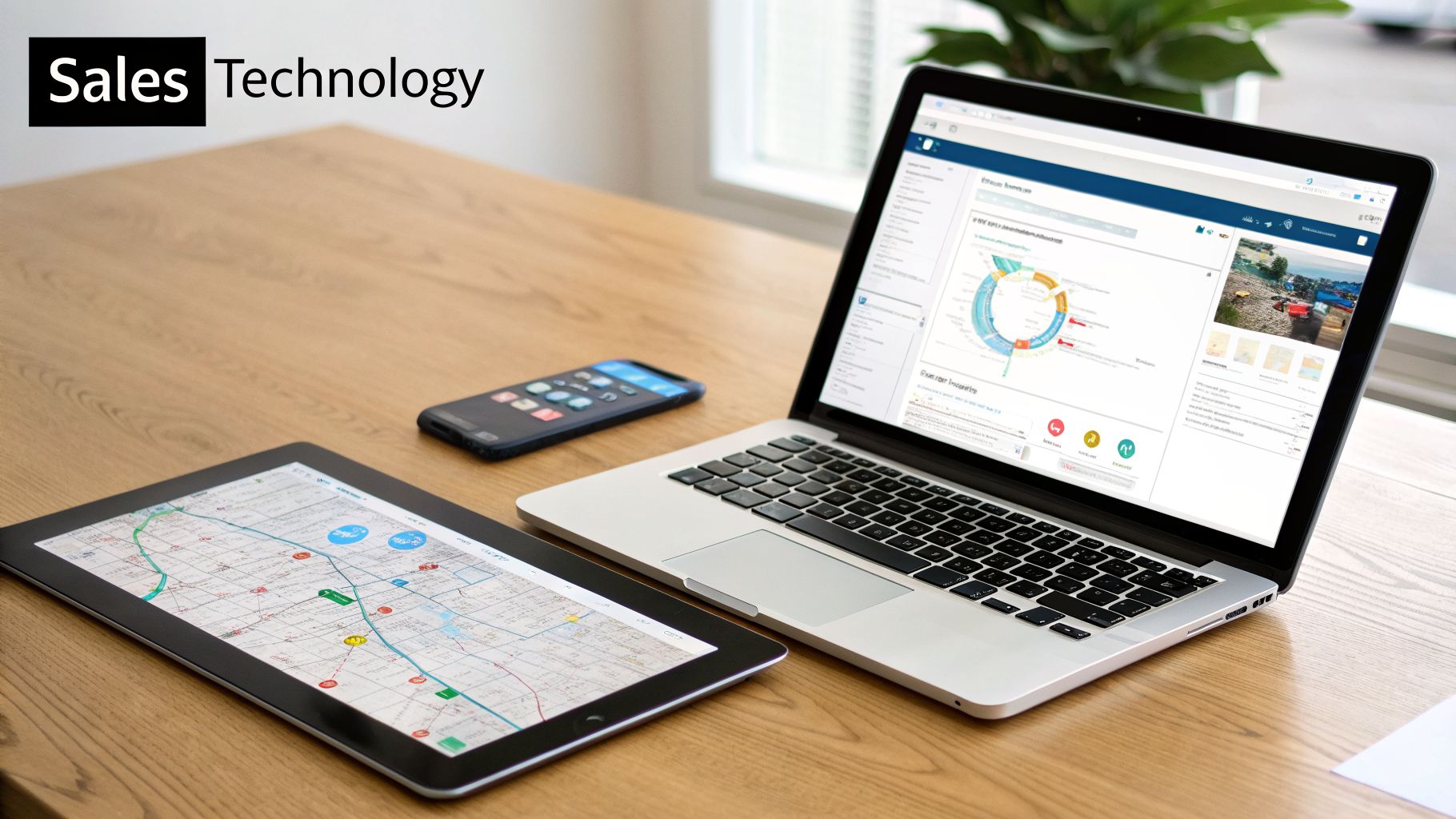
The tools a sales team uses aren't just add-ons; they define how reps work and ultimately, how they win. The difference in technology between inside and outside sales is one of the clearest indicators of their distinct missions. One stack is built for digital efficiency and scale, while the other is all about empowering autonomy in the field.
An inside sales rep lives in their tech stack. It's an interconnected digital ecosystem designed to maximize activity, automate the mundane, and surface deep data insights at every turn. This stack is the engine that allows a single rep to juggle hundreds of prospects without dropping the ball.
On the flip side, an outside sales rep's toolkit is designed for a completely different reality. While they still need a central CRM, their supporting tech has to work flawlessly on the move, helping them be effective hundreds of miles from the home office.
The Inside Sales Stack: Built for Volume and Velocity
The inside sales tech stack is all about integration and data flow. Every tool speaks to the others, creating a command center that helps reps execute high-volume outreach with speed and precision.
Key components almost always include:
- Customer Relationship Management (CRM): This is the foundation. A robust CRM like Salesforce serves as the single source of truth for all prospect and customer data, tracking every touchpoint and managing the pipeline.
- Sales Engagement Platforms: Tools like Outreach or Salesloft are the workhorses. They orchestrate multi-channel cadences—automating email sequences, teeing up calls, and analyzing what's working so follow-up is relentless and consistent.
- Auto-Dialers: To hit the necessary call volume, inside sales reps depend on power or parallel dialers. These tools are game-changers, automatically dialing lists and connecting reps only when a human answers, which dramatically cuts down on manual effort.
- Conversation Intelligence: Platforms that record, transcribe, and analyze calls are no longer a luxury. They give managers priceless insight into what top performers do differently and provide data-backed coaching opportunities for the whole team.
For an inside sales team, technology is a massive force multiplier. It gets the low-value work out of the way so reps can focus on what they do best: having meaningful conversations with qualified prospects.
The Outside Sales Stack: Built for the Field
An outside sales rep's tech stack is tailored for life on the road. The focus shifts to mobile access, logistical support, and tools that make in-person interactions smoother and more impactful. The tech needs to be lightweight, dead simple to use, and reliable from anywhere.
Essential tools for a field seller look quite different:
- Mobile CRM Access: This is absolutely non-negotiable. Reps must be able to pull up account history, log meeting notes, and update deal stages from their phone or tablet the second they walk out of a client's office.
- Route Planning & Optimization: Software that maps the most efficient routes between appointments is a lifesaver. It minimizes drive time and maximizes the precious hours reps get to spend face-to-face with customers.
- Expense Tracking Software: Let's be honest, managing receipts for travel and client dinners is a huge headache. Apps that automate expense tracking allow reps to snap a photo and move on, keeping them focused on selling, not accounting.
- Digital Presentation Tools: Even though the meeting is in person, the pitch is usually digital. Outside reps need polished, reliable tools to present on a laptop or tablet, often without a great internet connection.
Understanding the purpose behind each stack is crucial. One is engineered to run a high-velocity, centralized sales floor. The other empowers a distributed, autonomous team to build deep relationships in person.
Analyzing Cost-Effectiveness and Scalability
When building a sales organization, two of the first questions you'll ask are: "What will this cost?" and "How fast can we grow?" The answers to these questions are where the paths of inside and outside sales diverge dramatically, directly impacting your financial model and go-to-market speed.
For any leader focused on building a predictable revenue engine, getting this analysis right is non-negotiable.
The most glaring difference is the cost per interaction. An outside sales model, by its very nature, comes with a heavy price tag for travel, meals, and entertainment—the necessary expenses of building face-to-face relationships.
Inside sales operates on a completely different financial plane. By cutting out travel and using technology as the primary tool for engagement, these teams can drive a much higher volume of interactions for a fraction of the cost. This has a direct and powerful effect on your customer acquisition cost (CAC).
The Financial Breakdown
The numbers tell a stark story. An inside sales call costs roughly $50, while a single field sales visit can average a staggering $308. That's a cost difference of over 500% for just one touchpoint. This gap gets even wider when you look at the total overhead. Research shows that running an inside sales team is 40-90% cheaper than a comparable outside team.
But it's not just about raw cost; it's about efficiency. Where is that money actually going? Inside sales reps typically spend 35% of their time on active selling. Their outside counterparts? Just 22%, with the rest of their week often eaten up by windshield time and travel logistics. Simply put, every dollar invested in inside sales buys you more selling.
Scalability and Market Coverage
This is where the inside sales model truly shines. It's built for rapid growth. Need to expand the team? You're looking at a laptop, a headset, and access to your tech stack. New reps can be onboarded, trained, and hitting quota in weeks, not months.
This agility allows a business to ramp up its outreach capabilities almost on demand.
- Faster Ramp Time: A structured, data-driven environment means new inside sales reps often hit full productivity within 4-6 weeks.
- Wider Market Reach: Geography becomes irrelevant. A single team in one office can cover the entire country—or the world. One rep can talk to a prospect in New York in the morning and another in California after lunch.
- Higher Volume: The model is designed for high-volume outreach. Reps can connect with 40-60 prospects every day, enabling a company to saturate its addressable market far more quickly than a field team ever could.
The market has already voted with its hiring budgets. Companies are now hiring inside sales reps at a 10:1 ratio compared to outside sales professionals. This isn't a fleeting trend; it's a strategic shift toward building digital-first sales engines that prioritize cost-effective, scalable growth.
Outside sales, on the other hand, is built for depth, not speed. Scaling requires careful territory planning, hefty travel budgets, and a much longer ramp-up as reps establish a physical presence and build relationships in their regions. It's an effective model for high-value, complex deals, but rapid expansion presents a major logistical and financial challenge.
Choosing the Right Sales Model for Your Business
Figuring out whether to build an inside or outside sales team is one of the most critical decisions you'll make. It's not just a small tactical adjustment; this choice defines your cost of sale, your scalability, and the very rhythm of your go-to-market strategy. We've already looked at the day-to-day differences, so now let's build a practical framework for deciding what's right for you.
This isn't about which model is inherently "better." It's about finding the right fit for your product's complexity, your average deal size, and the customers you're trying to reach.
When to Choose an Inside Sales Model
An inside sales model is built for speed and efficiency. If your business depends on reaching a high volume of prospects quickly and cost-effectively, this is the engine that will drive your growth. It's the perfect fit for situations with shorter sales cycles where you can show your product's value without ever needing a handshake.
You should lean toward an inside sales team if your business fits this profile:
- Lower to Moderate Deal Sizes: This model is most profitable for products and services that typically fall under $50,000 ACV. The lower cost-per-acquisition just makes sense for smaller contracts.
- Shorter Sales Cycles: When deals close in a matter of weeks or a couple of months, the high-velocity nature of inside sales keeps the pipeline humming and revenue predictable.
- Standardized Products: If your solution doesn't need heavy customization or complex on-site installations, its value can be easily demonstrated through a solid web demo.
- High-Volume Lead Generation: To hit your numbers, your reps need to connect with 40-60 prospects a day. That kind of scale is only possible with the digital-first tools an inside team uses.
When to Choose an Outside Sales Model
For some deals, nothing replaces a face-to-face meeting. Outside sales (or field sales) is essential when the stakes are high and success depends on building deep trust and navigating complex organizations. This model is an investment in relationships, not just transactions.
An outside sales model is the way to go when you're dealing with:
- High-Value, Complex Deals: For contracts well over $50,000 and often into the six or seven figures. The higher cost of having a rep on the road is easily justified by the huge potential return.
- Long and Complicated Sales Cycles: When a deal takes months or even years to close and requires buy-in from multiple departments, you need a field rep on the ground to build consensus.
- Custom or Technical Solutions: If your product requires on-site assessments, deep discovery sessions, or tricky integrations, being there in person is non-negotiable.
- Traditional Industries: Some sectors, like manufacturing, construction, and healthcare, have a business culture where in-person meetings are a sign of commitment. A handshake is still part of the deal.
This simple flowchart boils the initial decision down to its core—the nature of your deals.
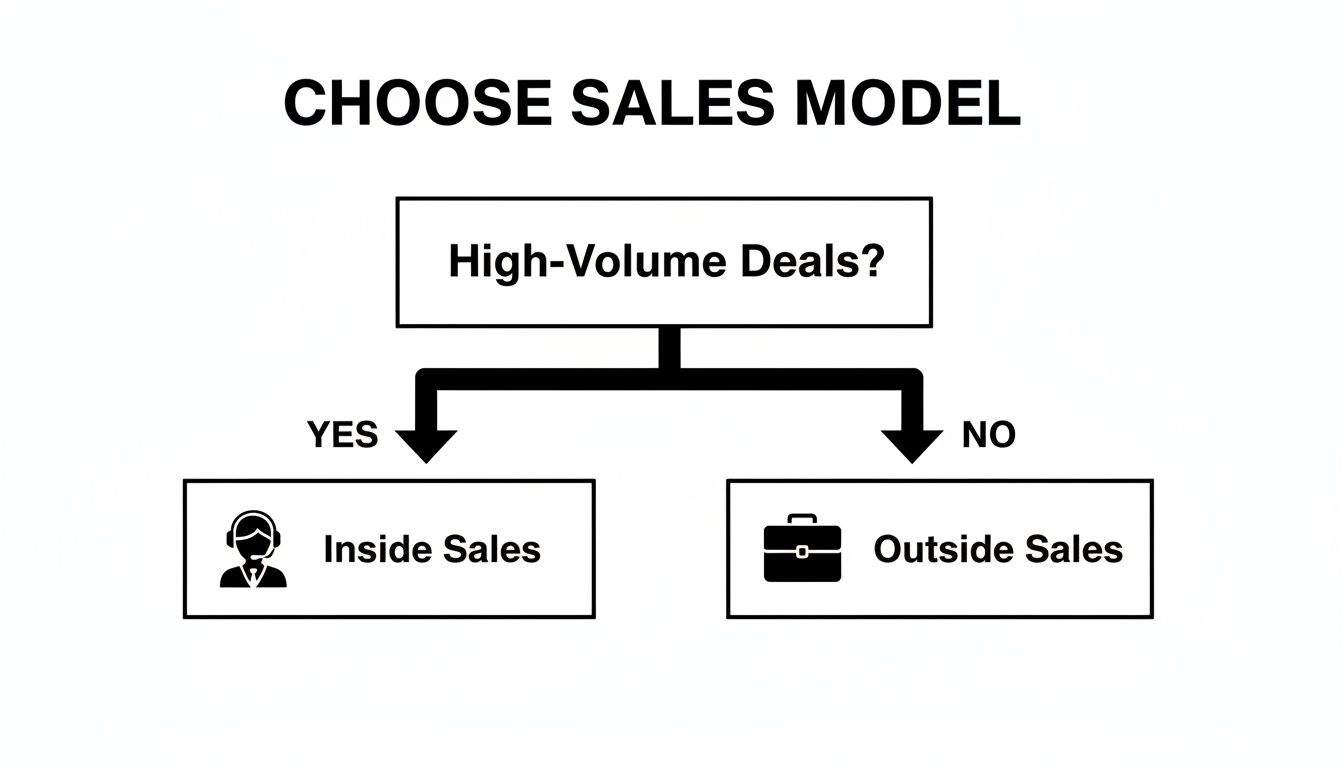
As you can see, the path is pretty clear. If you're built to handle a large volume of straightforward deals, inside sales is your answer. If you're chasing fewer, more complex opportunities, you need an outside sales team.
The Power of a Hybrid Approach
Of course, for many B2B companies, the real answer isn't choosing one or the other. The most effective sales organizations today often run a hybrid model, combining the strengths of both approaches to create a powerful and efficient sales machine.
The modern sales playbook is not about replacing outside sales but augmenting it. A hybrid model allows you to scale prospecting with an inside team while reserving your most expensive resources—field reps—for high-stakes, closing conversations.
In a typical hybrid setup, the inside sales team acts as Sales Development Representatives (SDRs). They do the heavy lifting of high-volume prospecting, qualifying leads, and setting those crucial first meetings.
Once an opportunity is qualified and hits a certain threshold (like a potential deal size), it gets passed to an outside account executive to take it over the finish line. This model gives you the best of both worlds: efficiency at the top of the funnel and experienced, hands-on attention where it matters most.
Ready to scale your outbound prospecting without the overhead of building an entire inside sales team from scratch? RevoGTM delivers a fully managed, high-velocity outbound engine to book qualified meetings directly on your calendar. Let us handle the strategy, data, and execution so your team can focus on closing. Learn more at RevoGTM.
Want results like this for your business?
We build the cold email infrastructure that books qualified meetings on autopilot.
Book a CallMore from the blog
Top LinkedIn Marketing Agencies for B2B SaaS Growth
Tired of generic advice? Find, vet, and manage top LinkedIn marketing agencies delivering qualified meetings at scale for B2B SaaS revenue teams.
closing statements for emails8 B2B Closing Statements for Emails That Get Replies (2026)
Stop using 'Best regards.' Discover 8 expert-approved closing statements for emails in B2B, with templates for cold outreach, follow-ups, and more.
what is an inside sales representativeWhat Is an Inside Sales Representative: A 2026 Guide
Understand what is an inside sales representative in 2026. Learn about their role, essential skills, key metrics, & how to scale for predictable revenue.