
A Modern Guide to Appointment Setting for B2B in 2026
B2B appointment setting is how you turn a list of prospects into a pipeline of qualified sales meetings. It's the critical step that bridges the gap between outbound prospecting and predictable revenue.
B2B appointment setting is how you turn a list of prospects into a pipeline of qualified sales meetings. It's the critical step that bridges the gap between outbound prospecting and predictable revenue, filling your team's calendar with conversations that actually have a chance of closing.
Rethinking B2B Appointment Setting Beyond Cold Calls

Let's be honest: the old "smile and dial" approach is dead. If your strategy for 2026 still involves buying a stale list and hitting "send" on a generic email blast, you're falling behind. Today's buyers are buried in noise and have zero patience for lazy outreach.
This playbook is for the SaaS founders and revenue leaders who are ready to stop guessing and start building a customer acquisition machine. We're moving past the brute-force numbers game and into a sophisticated system for creating a predictable pipeline.
The Modern Outbound Philosophy
Modern appointment setting isn't about begging for 15 minutes of someone's time. It's about earning that time by being hyper-relevant and genuinely valuable from the very first touchpoint.
This boils down to three core pillars:
- Surgical Targeting: Forget basic firmographics. True targeting means finding accounts with active buying signals. Did they just get a round of funding? Are they hiring for a new Head of Engineering? Are they using a technology that integrates perfectly with your solution? That's your in.
- Omni-channel Outreach: Your prospects live on more than just email. A great strategy coordinates outreach across cold email, LinkedIn, and even targeted cold calls. Someone might ignore your first two emails but then see your thoughtful LinkedIn message referencing them—that's how you cut through the noise.
- Deep Personalization at Scale: This isn't just about using a first name token. It's about referencing a podcast they were on, mentioning a recent company announcement, or speaking directly to a challenge you know their specific role faces. Technology makes this possible without having to write every single message from scratch.
The real goal is to start a conversation so relevant that a meeting becomes the natural next step. You're not just booking a demo; you're solving a problem.
Why Traditional Models Fall Short
Many companies get burned by traditional appointment setting agencies. I've seen it happen time and again. These services often run on overworked sending domains, tired scripts, and a model that incentivizes them to book any meeting, regardless of quality.
The result? Your sales team wastes time on calls with unqualified leads who were strong-armed into a meeting they never really wanted. It's a classic case of quantity over quality.
This guide gives you the playbook to build a better system. Whether you decide to build it in-house or partner with a high-velocity firm like RevoGTM, these principles will help you build a scalable process that fills your pipeline with genuinely qualified opportunities.
Building Your Outbound Strategy Foundation
Let's be honest: most B2B appointment setting campaigns are dead on arrival. The failure doesn't happen when a prospect ignores your email; it happens way before that, in the planning phase. Without a rock-solid foundation, even the most clever outreach is just noise.
This is where you stop thinking vaguely about who you sell to and start building a strategic blueprint for your entire outbound machine.
Pinpointing Your Ideal Customer Profile
It all starts with your Ideal Customer Profile (ICP). And I don't mean just jotting down basic firmographics like company size and industry. A truly powerful ICP gets specific about the pain points, business triggers, and tech stacks that signal a company is ready to buy.
Ask yourself: what makes a company a perfect fit for us right now? Get more granular than "they're a B2B SaaS company."
A sharp ICP isn't just a document—it's the bouncer for your sales pipeline. It makes sure your team only spends time on accounts that will actually see value and, more importantly, become high-value customers down the line.
When you're dialing in your ICP, think in layers:
- Firmographics: The basics still matter. Nail down your non-negotiables for company size (by employee count or revenue), industry, and geography.
- Technographics: What tools are they already using? Knowing they use Salesforce, HubSpot, or even one of your direct competitors is a massive strategic advantage. It gives you an angle.
- Buying Signals: This is where the real opportunity lies. These are the time-sensitive triggers that scream "we have a problem you can solve!" Think recent funding rounds, hiring for key roles (like a "VP of Sales Operations"), a sudden spike in job postings, or even a public complaint about their current vendor.
Your ICP should be so precise that when you find a company that fits, you know—with a high degree of confidence—that they have a problem you can solve. This is the core of effective appointment setting for B2B.
Sourcing High-Quality Prospect Data
Okay, you have a razor-sharp ICP. Now what? You need to build a list of companies and contacts that actually match it. This is where many teams stumble.
Don't fall into the trap of buying cheap, generic lists. They're often packed with outdated contacts and will absolutely destroy your domain's reputation. It's the fastest way to get your emails sent straight to spam.
Instead, build your own targeted lists by pulling from multiple sources. Combining data from different platforms gives you a much richer and more accurate view. For instance, LinkedIn Sales Navigator might show you a company fits your firmographic profile, while a tool like Apollo.io reveals they just started hiring for a role that signals a need for your solution.
If you want to find more companies that look just like your best customers, check out our guide on finding lookalike companies to expand your search. Remember, data sourcing isn't a one-and-done task. It's a continuous process of cleaning, enriching, and validating your lists to keep your outreach effective.
Mapping and Tiering Your Total Addressable Market
Once you have a solid list of ICP-fit accounts, you've defined your Total Addressable Market (TAM). But here's the reality: not all of those accounts are created equal. You can't give every single prospect the same level of white-glove, hyper-personalized attention. It's just not scalable.
The solution is to segment your TAM into tiers. This simple move lets you focus your best efforts on your best-fit accounts.
| Tier | Account Profile | Outreach Strategy | Personalization Level | Example Goal |
|---|---|---|---|---|
| Tier 1 | Top 1% of ICP-fit accounts. These are your "dream clients." | Highly bespoke, manual 1-to-1 outreach. No automation. | Deep research on the individual, their role, and the company's recent initiatives. | Book a meeting directly with a key C-level decision-maker. |
| Tier 2 | Strong ICP-fit with multiple buying signals detected. | Signal-based sequences; can be semi-automated. | Personalized opening line referencing a specific trigger (e.g., a new hire or funding round). | Start a conversation around a specific, timely pain point. |
| Tier 3 | Broad ICP-fit, but with fewer obvious buying signals. | High-volume, automated outreach that's still relevant. | Personalization based on their role, industry, or a common challenge. | Generate initial interest and qualify for a deeper conversation. |
By segmenting your market, you make a strategic trade-off: you reserve your most time-intensive, personalized efforts for the accounts that can deliver the biggest return.
This isn't just theory. The data shows that campaigns using three or more channels see 287% higher engagement. When you layer in that high-quality personalization, you can see transaction rates up to six times higher. Add in AI-driven lead scoring—which 75% of teams are already using to boost acceptance rates by 32%—and you've built a predictable machine for growth.
Executing High-Velocity Omni-Channel Campaigns
Alright, the strategic groundwork is done. You've defined your ICP and meticulously segmented your market. Now for the fun part: turning that planning into conversations. This is where your B2B appointment setting strategy comes to life through active, intelligent outreach.
Success here isn't about just blasting messages across every channel you can think of. The biggest mistake I see is teams treating each channel like a silo—a cold email here, a random LinkedIn message there. That's just noise.
A true omni-channel approach is about synergy. Your cold emails, LinkedIn activity, and calls should all work together, telling a cohesive story. Each touchpoint is designed to build familiarity and earn a sliver of trust before you ever ask for a meeting.
Before a single email is sent, however, you have to get your foundation right. This is the non-negotiable prep work that separates high-performing teams from the ones who just spin their wheels.
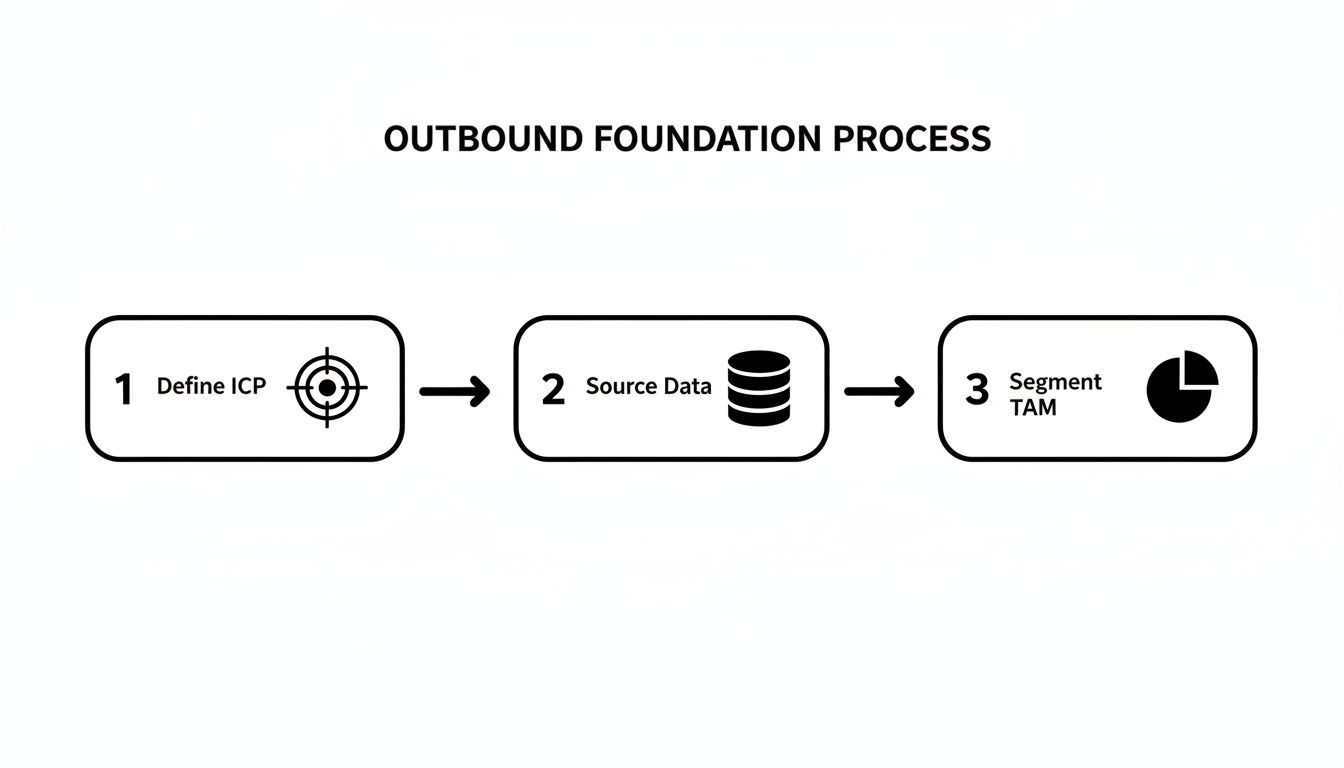
This process makes it crystal clear: your campaigns are won or lost in the strategy, data, and segmentation phases—long before your prospect ever sees your name.
Crafting Compelling Outreach Copy
Think of your outreach copy as your one chance to get a foot in the door. If it reads like a generic template you copied and pasted, that door will get slammed shut—fast.
Effective copy isn't about you or your product's amazing features. It's about them. It shows you've done your homework and have a legitimate reason to be in their inbox. The goal is simply to start a conversation, not close a deal on the spot.
I've seen thousands of messages, and the ones that work consistently nail these four elements:
- The Personalized Opener: This is your first impression and it has to be specific. Reference a recent funding announcement, a post they shared on LinkedIn, or a new executive hire.
- The Problem Hypothesis: Based on your research, state a common problem they're likely facing. Phrasing it as a question is a great way to invite a response.
- The Value Proposition Bridge: This is where you connect their potential problem to what you do, but without listing features. Keep it brief.
- The Low-Friction Call-to-Action (CTA): Drop the hard sell. Asking "Are you free for a demo next week?" is too much, too soon. Instead, go for an interest-based CTA that lowers the barrier to reply, like "Worth a deeper conversation?" or "Is this a priority for you right now?"
Designing Your Omni-Channel Sequence
A sequence is far more than just a series of automated emails. It's a carefully choreographed dance across multiple channels over several weeks, ensuring you stay top-of-mind without becoming a pest.
An effective sequence tells a story. Each touchpoint builds on the last, creating a cohesive narrative that shows you've done your homework and respect the prospect's time.
The intensity and structure of your sequence should absolutely vary based on who you're targeting. A Tier 1 "dream client" deserves a highly manual, bespoke sequence, while a Tier 3 campaign can lean more on automation.
Here's a sample framework for a powerful 10-step sequence over 21 days that we've seen work wonders:
- Day 1 (Email): Send a highly personalized email centered on a specific buying signal or research point.
- Day 2 (LinkedIn): A simple profile view. It's a subtle touch that shows you're engaged.
- Day 3 (LinkedIn): Send a connection request with a short, non-salesy note that references your email.
- Day 5 (Email): Follow up on your first email, but this time offer a valuable resource like a relevant case study or an industry benchmark report.
- Day 8 (LinkedIn): If they accepted your request, send a brief message with a helpful tip related to their role or industry. No ask.
- Day 10 (Call): For high-value prospects, a quick call can work miracles.
- Day 12 (Email): A short "bump" email to bring your thread back to the top of their inbox.
- Day 15 (LinkedIn): Find one of their posts and engage with it—a like or a thoughtful comment.
- Day 18 (Email): The "break-up" email. Politely state you'll stop reaching out for now but leave the door open for the future.
- Day 21 (Call): One final call for the highest-priority accounts if you haven't heard anything back.
Ensuring High Deliverability
All this strategic work is completely wasted if your emails land in spam. Getting the technical setup right is a non-negotiable part of high-velocity appointment setting.
You can't just buy a new domain and start blasting thousands of emails. You need to properly warm it up over several weeks to build a good sending reputation.
This means using dedicated sending domains and inboxes—completely separate from your primary corporate domain—to protect your main email reputation.
Managing Replies and Qualifying Interest
Seeing replies roll in from a cold outreach campaign is a great feeling. That's a win. But this is where the real work begins, and frankly, it's where most appointment setting efforts fall flat on their face.
An unmanaged inbox full of vague, one-line responses quickly turns from an opportunity into a liability. Leads that showed a flicker of interest go cold because nobody got back to them fast enough. This is the critical moment where process and speed make all the difference.
A prospect who raises their hand needs an answer in minutes, not hours. Anything less, and you're letting a potential meeting—and revenue—slip away.
Taming the Inbox Chaos: A Triage System for Replies
You can't just treat your reply inbox as a first-in, first-out to-do list. That's a recipe for disaster. To scale, you need to bring order to the chaos by triaging every single response the moment it arrives.
We break replies down into a few simple buckets. This lets anyone on the team instantly know what to do next and focus their energy on the conversations that matter most.
- Interested: The golden replies. They ask for a demo, want to see pricing, or say "tell me more." These are your highest priority. The goal is to get a calendar link in front of them immediately.
- Referral: The prospect says, "You should talk to Jane in Marketing instead." This is a warm handoff. Your very next step is to start a new sequence to Jane, name-dropping the person who referred you.
- Not Now / Bad Timing: They might say the idea is interesting, but the timing is off. Don't discard these! These are pure gold for your long-term nurture pipeline. Tag them and set a reminder to follow up in a few months.
- Objection: They push back with things like "we already use a competitor" or "we have no budget." This isn't a "no"—it's an invitation to have a real conversation.
- Unsubscribe / Not Interested: A clear "no." Respect it. Immediately remove them from all sequences and wish them well. No means no.
Categorizing replies turns a reactive, chaotic process into a proactive system. You know exactly what the next step is for every single response, ensuring no warm lead ever slips through the cracks.
Protecting Your AEs: Defining a Sales Qualified Appointment
Let's be clear: not every meeting is a good meeting. Throwing unqualified prospects on your Account Executives' calendars is the fastest way to destroy morale and waste your most expensive resource—their time.
This is why you absolutely must have a crystal-clear definition for a Sales Qualified Appointment (SQA). An SQA is a meeting that meets a strict, pre-defined set of criteria, ensuring your sales team only speaks to prospects who have a real shot at becoming customers.
Building a "Lite" Qualification Framework for Outreach
You're not trying to run a full BANT (Budget, Authority, Need, Timeline) discovery process over email. That's what the meeting is for. The goal here is to get just enough signal to confirm the meeting is worth your AE's time.
Think of it as BANT-lite:
- Authority: Is this person a Director, VP, or C-level? Your ICP should already tell you if their title has buying power or significant influence.
- Need: Did they respond to your email in a way that acknowledges the pain point you mentioned? A simple "This is interesting, we've been struggling with that" is a huge green light.
- Timeline: You won't always get this, but sometimes a prospect will volunteer it. A reply like "We're planning for this in Q3" helps you gauge urgency.
- Budget: This is nearly impossible to qualify over email. Instead, use a proxy. Does their company size, industry, or recent funding rounds suggest they can afford your solution?
Your SQA definition should be a simple checklist that everyone agrees on. For example: "A confirmed meeting with a Director+ at a 200+ employee tech company who has acknowledged a problem related to our core value prop."
Measuring Performance and Scaling Your Engine

If you're running an outbound program without closely tracking performance, you're essentially flying blind. You might be getting some results, but you have no real idea why or how to get more of them. A world-class appointment setting for B2B strategy isn't built on guesswork; it's built on data.
The first step is to stop obsessing over vanity metrics. Open rates, for instance, are notoriously unreliable these days. Instead, you need to zero in on the numbers that actually impact your pipeline and revenue. These are the true vital signs of your outbound health.
The Only Metrics That Really Matter
To get a real grip on performance, you don't need an overly complex dashboard. In my experience, a handful of core KPIs can tell you almost everything you need to know about what's working and what's not.
Think of it as tracking the prospect's journey through your funnel:
- Reply Rate: Are people actually responding? This is your first real signal. If this number is low, your messaging, value proposition, or even your technical deliverability could be the problem.
- Positive Reply Rate: Of those who reply, how many are genuinely interested? This separates the polite "no, thank yous" from the "tell me more"s. This metric is the purest measure of your copywriting and offer.
- Meetings Booked (SQAs): This is the ultimate output. How many of those interested prospects turn into Sales Qualified Appointments that your sales team will actually accept? This is your north star.
- Cost Per Appointment: How much are you really spending to get one qualified meeting on the calendar? Tally up your total monthly spend—tools, salaries, data—and divide it by the number of SQAs booked.
Once you start tracking these numbers, you can stop guessing and start engineering success. You can test a new subject line or a different call-to-action and see, in black and white, how it affects your results.
Moving From Startup to Scale-Up
So you've built a system that's booking a few solid meetings a week. Fantastic. The next question is always, "How do we get more?" This is where you shift from an early-stage hustle to building a predictable, scalable engine.
This is all about creating a system. In the competitive B2B space, we see top-performing appointment setters consistently booking 10-15 qualified meetings per week. That's the benchmark for teams that are truly scaling, focusing on ICP-fit leads that build a real pipeline.
When you're ready to hit that kind of volume, it's usually time to hire your first Sales Development Rep (SDR).
The Scaling Dilemma: Build vs. Buy
Bringing on your first SDR is a huge milestone, but it presents a critical strategic crossroads: do you build an SDR team in-house, or do you "buy" the capability by outsourcing to a specialized agency?
There's no one-size-fits-all answer. The right choice really depends on your company's stage, internal resources, and how quickly you need to see results.
The "Build" Path: Hiring Your Own SDRs
Building an in-house team gives you complete control. Your SDRs will live and breathe your company culture, with direct access to your product and sales leaders. If you have the time and resources, it's a powerful long-term play.
But don't underestimate the overhead. The "build" path is a serious commitment:
- Hiring & Onboarding: Finding, interviewing, and properly training a great SDR can easily take a few months.
- Management Overhead: An SDR team needs constant coaching, performance tracking, and a clear career path to prevent burnout and turnover.
- The Tech Stack: You're on the hook for researching, buying, implementing, and managing the entire suite of outreach tools.
The "Buy" Path: Partnering with an Agency
Outsourcing to a high-velocity partner like RevoGTM is a decision to buy two things: speed and expertise. You're effectively plugging into a finely tuned machine that's ready to go from day one. An agency brings the proven strategy, data sources, tech stack, and trained specialists to the table.
This path is often the smartest move when:
- You need to generate pipeline much faster than you can hire.
- Your current team doesn't have deep, hands-on experience in modern outbound.
- You want to test a new market or ideal customer profile without pulling focus from your core business.
A good partner handles everything—from building the lists and warming up the domains to managing every reply and booking the qualified meeting right onto your Account Executive's calendar. It lets your team do what they do best: close deals.
Your Top B2B Appointment Setting Questions, Answered
Even the most buttoned-up strategy hits a few bumps when it meets the real world. As you start putting your appointment setting plan into motion, you're bound to have questions pop up. It happens to everyone.
Let's walk through some of the most common things founders and sales leaders ask me when they're trying to build a pipeline that actually delivers. Getting these right will save you a ton of headaches down the road.
What's the "Magic Number" of Touchpoints for a Sequence?
Everyone wants to know the perfect number of times to reach out. But honestly, the raw number is only half the story. The real secret is in the mix of channels and the story you're telling.
We've run thousands of campaigns, and the data consistently points to an 8 to 12 touchpoint sequence over three or four weeks as the sweet spot. Anything less, and you're leaving meetings on the table. Anything more, and you risk annoying your prospects.
A sequence that actually works is a cohesive narrative, not just the same "checking in" email sent eight times. A solid mix usually looks something like this:
- The backbone of your outreach: 4-5 personalized emails, each offering a new perspective or a different piece of value.
- Smart social engagement: 2-3 LinkedIn actions—think a profile view, a thoughtful connection request, and a follow-up message that doesn't just re-state your email.
- The human touch: 1-2 strategic phone calls saved for your Tier 1 and Tier 2 accounts. A real conversation can cut through the digital noise like nothing else.
When you show up in different places with a consistent message, you become a helpful, persistent resource instead of just another automated email bot.
What's the Real Difference Between an MQL and an SQA?
Getting this distinction wrong is a classic way to create friction between your marketing, SDR, and sales teams. It's a crucial piece of the puzzle for a healthy pipeline.
A Marketing Qualified Lead (MQL) is someone who's shown passive interest. They downloaded an ebook, watched a webinar, or signed up for your newsletter. They've dipped a toe in the water but haven't asked to talk to anyone. They're usually still in the learning phase and need more nurturing.
A Sales Qualified Appointment (SQA) is what this whole playbook is about. It's a confirmed meeting on an Account Executive's calendar with a prospect who is ready to talk business.
An SQA represents active engagement and a direct path to pipeline revenue. While MQLs are about building an audience, SQAs are about building your sales forecast. For any appointment setting for B2B effort, the SQA is the ultimate goal.
This person fits your ideal customer profile, has the right job title, and has actively agreed to a meeting to discuss a potential need. An SQA signals real buying intent and is exponentially more valuable than an MQL.
When Is It Actually Time to Outsource Appointment Setting?
The "build vs. buy" debate is a big one, and it usually comes down to two pivotal moments in a company's growth.
The first is right after you've found product-market fit and you need to pour gas on the fire. You have to scale your sales pipeline faster than you could ever hire, train, and manage an internal SDR team. A great agency partner brings a proven playbook, the tech stack, and the expertise to start booking meetings in weeks, not months. It's about grabbing market share before your competition does.
The second common scenario is when an established sales team needs to break into a new market or go after a completely different customer profile. If your AEs are getting bogged down with prospecting, or your deliverability is in the gutter, it's a massive signal that you need a specialized partner. Outsourcing lets your closers focus on closing while a dedicated team handles the entire top of the funnel, from strategy all the way to a booked meeting.
Ready to turn your outbound strategy into a predictable revenue machine without the headaches? The team at RevoGTM delivers a fully managed prospecting engine that handles everything from data sourcing and infrastructure to inbox management and direct calendar booking. Stop guessing and start scaling with a partner built for high-velocity growth.
Want results like this for your business?
We build the cold email infrastructure that books qualified meetings on autopilot.
Book a CallMore from the blog
Top LinkedIn Marketing Agencies for B2B SaaS Growth
Tired of generic advice? Find, vet, and manage top LinkedIn marketing agencies delivering qualified meetings at scale for B2B SaaS revenue teams.
closing statements for emails8 B2B Closing Statements for Emails That Get Replies (2026)
Stop using 'Best regards.' Discover 8 expert-approved closing statements for emails in B2B, with templates for cold outreach, follow-ups, and more.
what is an inside sales representativeWhat Is an Inside Sales Representative: A 2026 Guide
Understand what is an inside sales representative in 2026. Learn about their role, essential skills, key metrics, & how to scale for predictable revenue.